Select a site alphabetically from the choices shown in the box below. Alternatively, browse sculptural examples using the Forward/Back buttons.
Chapters for this volume, along with copies of original in-text images, are available here.


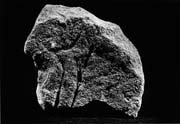
Object type: Fragment [1]
Measurements: H. 25 cm (9.8 in); W. 19.8 cm (7.75 in); D. 13.3 cm (5.25 in)
Stone type: See no. 2.
Plate numbers in printed volume: 191-194
Corpus volume reference: Vol 3 p. 78
(There may be more views or larger images available for this item. Click on the thumbnail image to view.)
A (broad): Two parallel incised lines, one with a cusp, cross the surface.
B (narrow): There are faint traces of a plain edge moulding.
C (broad): Plain.
D (narrow): Broken away.
The carving is too vestigial for safe assumptions. The cusp may represent the profile of a human head and shoulder. It may be a fragment from a shaft, or possibly a grave-marker. The archaeological context suggests a date no later than the tenth to eleventh centuries.
1. All the pieces from the Minster were discovered as a result of the excavations of 1966-71 by H. Ramm and D. Phillips. They are to be published as a handlist, together with a critical essay, in the forthcoming Royal Commission volume on the excavations. That publication will provide the finer detail of their archaeological contexts, both in a table, and in a description of the excavation of the south transept cemetery.
The following are general references to the stones: Wilson 1978, 142; Hall 1980b, 7, 21; Lang 1988b, 8, 12; Lang 1989, 5.
