Select a site alphabetically from the choices shown in the box below. Alternatively, browse sculptural examples using the Forward/Back buttons.
Chapters for this volume, along with copies of original in-text images, are available here.


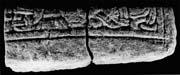
Object type: Part of hogback, in two joining pieces [1]
Measurements: L. 65 cm (25.5 in); W. 34.5 cm (13.5 in); D. 23.8 > 22.5 cm (9.5 > 9 in)
Stone type: Coarse-grained, feldspathic, pale brown (10YR 7/4–7/6) grit; see no. 2.
Plate numbers in printed volume: 190, 195-199
Corpus volume reference: Vol 3 p. 78
(There may be more views or larger images available for this item. Click on the thumbnail image to view.)
A (long): A single horizontal panel stretches the length of the vertical side formed by flat moulding. It contains disorganized interlace in a median-incised strand. The plinth below is plain but has a hogback profile.
B (end): Plain.
C (long): The panel has the same shape and mouldings as on face A. The ornament is too worn to decipher.
The proportions of this hogback resemble those of type h, the scroll type, but the ornament differs. The interlace is worn, but it is possible that it once included a fettered animal.
1. All the pieces from the Minster were discovered as a result of the excavations of 1966-71 by H. Ramm and D. Phillips. They are to be published as a handlist, together with a critical essay, in the forthcoming Royal Commission volume on the excavations. That publication will provide the finer detail of their archaeological contexts, both in a table, and in a description of the excavation of the south transept cemetery.
The following are general references to the stones: Wilson 1978, 142; Hall 1980b, 7, 21; Lang 1988b, 8, 12; Lang 1989, 5.
