Select a site alphabetically from the choices shown in the box below. Alternatively, browse sculptural examples using the Forward/Back buttons.
Chapters for this volume, along with copies of original in-text images, are available here.


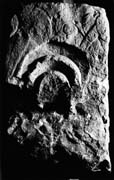
Object type: Part of cross-shaft
Measurements: H. 63.3 cm (24.9 in); W. 32 cm (12.6 in); D. 33.5 cm (13.2 in)
Stone type: Fine-grained, dolomitic, white to very pale brown (10YR 8/2–8/3) limestone, with small cavities; Lower Magnesian Limestone, Upper Permian; reused Roman ashlar, originally from Tadcaster area (see Fig. 5).
Plate numbers in printed volume: 342-346
Corpus volume reference: Vol 3 p. 105-107
(There may be more views or larger images available for this item. Click on the thumbnail image to view.)
A: At the top is an extremely worn frieze of angels, whose faces are placed on the corner of the shaft. Their pelta-like upper wings meet in the centre of the face, and below their chins a sub-acanthus lower wing fills the spandrel. Both wing elements terminate in tight volutes.
The lower part of the face is cut away and the corners are lost. An arch is cut deeply into the surface and surmounts the top of Christ's head and a dished halo. Martin Blindheim noticed in 1977 that the nimbus has a cross upon it, formed by a series of parallel scratches.
B: This, the best preserved side, retains its right-hand edge moulding. It is cut in a series of apparently descending levels, ending in a diagonal. The moulding is laid in vertical strips with narrow beading on their edges. A bold transverse bar crosses them.
The angel frieze is well preserved here. The angels have incised facial features. Their hands reach down to grasp the arch of the panel below, and their sleeves have pairs of incised horizontal bands. The upper wing has a contoured arc at its base and a narrow incised double outline to the curved pinion. It ends in a tight volute.
The inset panel is arched and contains a beast-chain of interlocking bipeds which bite each other's tails. The tails and ears are extended into fetters which bifurcate as they bind the torsos. The animals have large chests, double outlines and domed heads with snub snouts. The large elliptical eyes are incised. They are carved in high relief and the background is cut back with a claw tool leaving the marks.
There are chisel and gouge marks on this face (Ill. 345), especially where the fetters cross, and in the picked areas are remains of red pigment. Some holes and scratches are constructional aids (Lang 1984b).
C: The lower part is cut away and the corners lost. The angel frieze is as on face B, except that there are more decorative strips applied to the upper wing. Along the top, intruding upon the wing, is a horizontal row of drilled holes.
The arched panel below contains a bird cut in high relief. Its head is thrown back, and it has a double outline with an incised elliptical eye. Its wing is spread horizontally and its incised strip features terminate in a scroll. Superimposed on the wing are two diverging strands which sprout from the bird's head; a small pellet lies in their junction.
D: Only part of the left-hand edge moulding survives: it has contoured vertical strips terminated at the top diagonally. The angel frieze at the top is identical with that on face C.
Within the arched panel is a symmetrical pattern of interlaced ribbon beasts with double outlines and incised elliptical eyes. They bite their bodies. Their ears are pricked and gouged; their snouts are snub. At the top of the panel the ribbon bodies erupt into a pair of large volutes with median incision. They are nipped and collared at the neck.
E (top): The top of the shaft is flat and retains the hole and some of the run lead for the fixing pin.
This is one of the most important monuments in York, for not only does it convey considerable information about designing and cutting a shaft, but it is attributable to a particular hand, the 'York Master', who also produced Clifford Street 1 and Coppergate 2 (see Chap. 10; Lang 1985, 130–5).
The York Master used fine-grained Magnesian Limestone which has preserved many of the layout lines and fix-points for disposing the ornament, as well as tooling marks of some variety (Ill. 345). The gesso and pigment which covered them remain only as flecks, except on Clifford Street 1. There is clear evidence of initial picking out with a small punch, use of chisels and narrow gouge, dividers or their equivalent, and claw-chisels for dressing back the ground. Axial lines and parallel verticals were dropped from equidistant fix-points near the top of the shaft. The design is controlled by a grid and its diagonals (Lang 1985, fig. 7), a method long established in Insular art but probably rare in Scandinavian Viking-period styles.
Perhaps because of the Anglo-Scandinavian floruit in York now being so firmly established archaeologically, there has been a readiness to consider Newgate 1 as a manifestation of the Jellinge style (Lang 1978c, 15; Bailey 1981b, 139). Undoubtedly the animals of Clifford Street 1 (Ills. 331–2) and the longer panel of Coppergate 2 (Ill. 327) merit the label, but recent studies have stressed the Englishness (Anglian qualities) of Newgate 1. The portrait of Christ with a dished halo on face A has a long pedigree: it occurs on the contemporary shaft, Minster 4 (Ill. 20), and can be traced back through pre-Viking pieces in the West Riding at Collingham and Otley as far as the late eighth century. Such conservatism is to be expected in religious portraiture, perhaps because of canons governing the conventions. The cruciferous halo extant at this period in York is an example.
The beasts of face B, because they are disposed in a chain and have double outlines and ear extensions, may appear Jellinge, but there are significant differences from the profile quadrupeds of the Metropolitan School. They are broad-chested bipeds with a tapering tail, domed head, stubby jowl without folds, and no scroll to the leg-joint. Their ancestry lies in manuscript decoration of the ninth and early tenth centuries in the south of England (Kendrick 1949, 29–30, figs. 1–2). Their slit mouths and habit of biting rather than interlocking are found in the Durham Ritual (Durham MS A. IV. 19, fol. 4r (Ill. 919)), and the Junius Psalter (Bodleian MS Junius 27), both from the early decades of the tenth century (Wormald 1945, pls. IIc, IVd; Wilson 1984, pls. 212–15). The saluting leg also has an English source in Mercian and Deiran Sculpture of the ninth century (Cramp 1978, figs. 1.1, 1.2). The only Scandinavian element on face A, and that a colonial one, is the bifurcating strand, which occurs elsewhere in York on the bone motif-piece from Coppergate (Tweddle 1980). The smaller animal of Coppergate 2 (Ill. 330) is identical with those of Newgate face B.
The ribbon beasts of face D do form a chain, though their biting heads are in the same tradition as face B's, with the tiny ears of the manuscript animals cited. The erupting scrolls, nipped by collars at the junction with animal, occur on the Skaill brooches (Graham-Campbell 1975–6, 120 ff., fig. 3), firmly dated to the tenth century, and on a wooden weaver's sword from Dublin (Lang 1988a, 12, no. DW23). The nipped, often paired, scroll is an Insular motif, not a native Scandinavian feature; it occurs too in the Durham Ritual (fol. 4r) in relation to an animal similar to those of face B (Ill. 919).
The angel frieze is copied from Nunburnholme 1, though it mistakes the acanthus below the arms for a lower pinion of the wing, suggesting the York Master worked after the Second Sculptor had completed the Nunburnholme shaft. The means of fixing the cross-head, with dowel, spike, and lead (some of it surviving) differs from Nunburnholme's carpentry technique.
