Select a site alphabetically from the choices shown in the box below. Alternatively, browse sculptural examples using the Forward/Back buttons.
Chapters for this volume, along with copies of original in-text images, are available here.


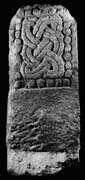
Object type: Part of cross-shaft
Measurements: H. 81.5 cm (32 in); W. 34 cm (13.4 in); D. 25.5 cm (10 in)
Stone type: Medium- to coarse-grained (with quartzite pebbles up to 6 mm), very pale brown (10YR 7/3) grit; Millstone Grit, Namurian, Upper Carboniferous; reused Roman ashlar, originally from Hetchell Crag or Otley areas (see Fig. 5).
Plate numbers in printed volume: 347-350
Corpus volume reference: Vol 3 p. 107-108
(There may be more views or larger images available for this item. Click on the thumbnail image to view.)
A (broad): There is a flat edge moulding, damaged in places, which passes above round a panel formed by bold pellet strips, some of them domed. They enclose a short run of four-strand plain plait using median-incised strands which are particularly broad. It is clumsily executed. The lower part of the face is undecorated.
B (narrow): The left-hand flat moulding survives. At the base of the panel is a horizontal run of four pellets, above which is a strip of double cable. Above this is an interlace exactly resembling face A's, though on a slightly smaller scale. The lower part of the stone is plain.
C (broad): Defaced.
D (narrow): The lower portion is plain. A row of pellets is surrounded by a strip of double cable, and there was a similar strip at the top. The worn interlace was probably the same as on the surviving faces. The lower part is plain.
This unambitious stone belongs to the York Plait and Pellet Group (see Chap. 10); it carries the limited repertoire of many York shafts cut from granular millstone grit. The plain plaits and liking for pellets is also found in some hogback ornament.
