Select a site alphabetically from the choices shown in the box below. Alternatively, browse sculptural examples using the Forward/Back buttons.
Chapters for this volume, along with copies of original in-text images, are available here.


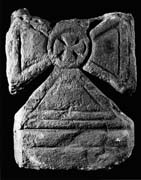
Object type: Part of cross-head (gable finial?)
Measurements: H. 40.6 cm (16 in); W. 31.2 cm (12.25 in); D. 20.3 cm (8 in)
Stone type: Medium-grained, very pale brown (10YR 7/3) grit; Millstone Grit, Namurian, Upper Carboniferous; reused Roman ashlar, originally from Hetchell Crag (Thorner) or Otley areas (see Fig. 5)
Plate numbers in printed volume: 399-402
Corpus volume reference: Vol 3 p. 115
(There may be more views or larger images available for this item. Click on the thumbnail image to view.)
The cross has wedge-shaped arms, type B8, with the narrowest of straight cut arm-pits. The stumpy base has short vertical sides.
A (broad): A broad, plain perimeter moulding runs round the whole face. The base is plain and surmounted by a broad, flat, transverse moulding. The lower arm has an additional inner plain moulding across its end. At the centre is a roundel containing a small cross in relief, type E8, with wedge-shaped arms and curved ends.
B–D: Plain.
Appendix A item (stones dating from Saxo-Norman overlap period or of uncertain date).
Collingwood regarded this as an eleventh-century finial cross. Certainly the cross shape has no local parallels in monumental sculpture. The cutting is fairly rough and the ornament basic enough to make dating hazardous. Similarly shaped finials of the twelfth century are found at Thorpe Bassett, East Riding, and Bulmer, North Riding.
