Select a site alphabetically from the choices shown in the box below. Alternatively, browse sculptural examples using the Forward/Back buttons.
Chapters for this volume, along with copies of original in-text images, are available here.


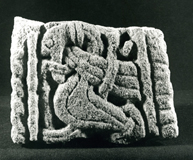
Object type: Fragment of cross-shaft
Measurements: H. 19.8 cm (7.75 in); W. 24.3 cm (9.6 in); D. 19.3 cm (7.6 in)
Stone type: Medium- to coarse-grained, feldspathic, very pale brown (10YR 7/4) grit; Millstone Grit, Namurian, Upper Carboniferous; from Hetchell Crag (Thorner) or Otley areas (see Fig. 5).
Plate numbers in printed volume: 293-296
Corpus volume reference: Vol 3 p. 96
(There may be more views or larger images available for this item. Click on the thumbnail image to view.)
A (broad): There is an outer cabled edge moulding and an inner roll moulding on a sharply tapering face. The panel within contains part of a bird-chain. The head, neck and breast of one bird survive in profile. Its eye is an incised ellipse and its body has a double outline. The drooping three-fold tail of an adjacent bird crosses its neck and the two are fettered with both plain and median-incised strands.
B (narrow): The moulding is damaged on the right-hand side but on the left it is an identical double version with face A's. Within the panel is bold median-incised interlace: probably part of a unit of simple pattern F.
C (broad): Damaged at both sides, the panel contains enigmatic features. The principal motif is a concentric circular feature with a pendant stem. The disc is over-ridden by an arc. To the left is a curving strand, to the right a vertical one, and two wedge-shaped blocks fill the base. The strands are humped in section.
D (narrow): Damaged on the left. Within an outer cabled and inner roll moulding is part of an interlace using median-incised strands: a unit of simple pattern F.
The bird-chain is confined chiefly to York sculpture: for example, Minster 2 (Ill. 11). The drooping tail of the bird and the proud chest have Mercian origins (Lang 1978b, 147, fig. 8.1), though its incorporation into a chain is a York characteristic. It should be compared with Minster 2 and St Denys 2 (Ill. 213). Here the double outline and fettering indicate a possible Jellinge-style reflex applied to the Anglian model.
The cutting is deep and the mouldings bold, reminiscent of Minster 2. It is impossible to reconstruct the pattern of face C, but through comparison with the design of the latter stone it seems likely to have been the principal face. Tweddle (1987, 155) has identified an animal's foot on face C, and has recently placed this monument in its local context.
