Select a site alphabetically from the choices shown in the box below. Alternatively, browse sculptural examples using the Forward/Back buttons.
Chapters for this volume, along with copies of original in-text images, are available here.


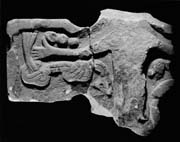
Object type: Part of cross-head, in two joining pieces
Measurements: H. 32.5 cm (12.75 in); W. 42.3 cm (16.7 in); D. 18.4 > 16.2 cm (7.25 > 6.4 in)
Stone type: Medium-grained, brown to strong brown (7.5YR 5/4–5/6) sandstone; deltaic channel sandstone, Saltwick Formation, Aalenian, Middle Jurassic; possibly from Aislaby, near Whitby (see Fig. 5).
Plate numbers in printed volume: 297-301
Corpus volume reference: Vol 3 p. 96-97
(There may be more views or larger images available for this item. Click on the thumbnail image to view.)
The cross-head was free-armed, of type A11. Only the centre and one lateral arm remain.
A (broad): The perimeter moulding is flat and plain. The centre of the cross-head is occupied by the damaged body of Christ. His head would have filled the upper arm, His legs the lower. The arm of Christ extends into the cross-arm; it is slightly bent at the elbow; the palm is spread and the thumb raised. Even though the surface of the figure is chipped away, the carving is in high relief and fully modelled. Beneath the elbow is a serpentine dragon, its head at Christ's side and its fan tail in the top left corner. Its body is median-incised and is knotted twice with Stafford Knots. The head is triangular. Above the elbow are three large, domed pellets. On the right-hand side, beneath the other arm, is the profile head of an animal, with lolling tongue, domed brow, and incised circular eye.
B (narrow): The end of the cross-arm has a flat perimeter moulding. The panel contains a closed circuit motif, in which a free ring is threaded through by diagonals forming a figure-of-eight. The strands are median-incised.
C (broad): The centre of the cross-head carries a very damaged human figure. The edge moulding is flat. The arm contains a large closed circuit motif in which a free ring is threaded through with pairs of pointed loops set back to back. The strands are median-incised. The left-hand side of it is confused, chiefly because of the fracture. A single large domed pellet fills the space between the points of the loops.
D (narrow): Lost.
The form of the cross is late Anglian (Coatsworth 1987, 161) and the naturalistic treatment of the figure of Christ suggests the kind of classicism found in ninth-century figure carving elsewhere in Yorkshire, for example, at Easby, North Riding. However, the ring-knot and the knotted dragon, which also appears on the Sigurð slab, Minster 34 (Ill. 147), point to the Anglo-Scandinavian period, as do the closed circuit motif on the arm-end, and the ring-knot of face C.
The position of the Crucifixion is that adopted on the Ryedale crosses: for example, Ellerburn 8 (Ill. 437), Sinnington 11 (Ill. 814), and Kirkdale 1 (Ill. 546). A similar Crucifix, cited by Coatsworth, is at Great Ayton, North Riding, to the north of the Moors. Its origin may well be Irish; in the light of the York-Dublin axis in the tenth century this would not be surprising. Coatsworth, whose recent study of this piece is very full (1987, 161–3), suggests that the serpents fulfil a local taste rather than derive from an iconographic model. The reverse face's figure could well be a Christ in Majesty (Hall 1975, 24) or a Judgement. That too would have Irish analogues in relation to the Crucifixion of the principal face, though Coatsworth prefers to see the Risen Christ on face C (op. cit. 161).
It could well be the model for Sinnington 11, which also has serpents below Christ's arms. The similarity of the dragons to the Minster's Sigurð slab suggests that they are by a single hand. The ring-knot of face C has many local parallels in metal and stone (Tweddle 1987b, 158, fig. 38). Its Borre-Style derived ring and return loops has another primitive parallel on a spoon from York (Waterman 1959, 86, fig. 15).
Despite its old-fashioned form, it is an adventurous monument and carved with confidence. It is an eclectic piece with Anglian form, Irish and Anglian derived iconography, and Scandinavian interlace motifs.
