Select a site alphabetically from the choices shown in the box below. Alternatively, browse sculptural examples using the Forward/Back buttons.
Chapters for this volume, along with copies of original in-text images, are available here.


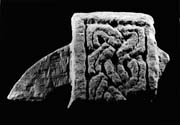
Object type: Part of cross-head
Measurements: H. 17.8 cm (7 in); W. 28.5 cm (11.25 in); D. 14.6 cm (5.75 in)
Stone type: Medium-grained, very pale brown to yellow (10YR 7/4–7/6) sandstone; see no. 2.
Plate numbers in printed volume: 306-307, 309-311
Corpus volume reference: Vol 3 p. 98-99
(There may be more views or larger images available for this item. Click on the thumbnail image to view.)
The cross was a ring-head with a ring, type 1(a), and straight arms, type A.
A (broad): The face of the cross-arm has a neat, plain edge moulding around its perimeter. It contains a four-strand plain plait, using median-incised strands, with rough, angular bends. The pattern has been created with a punch whose marks are very evident.
The ring is plain and recessed from the plane of the cross face. On the left-hand side it survives almost completely; on the right it is a mere stump.
B (narrow): Plain.
C (broad): The perimeter moulding is identical with face A's but contains extremely clumsy ring-twist with a bar terminal at the end of the panel. The diagonal strands and the bar terminal are median-incised, but not that of the warped free ring. A pellet filler is inserted on the left; it is embellished with a single central dot.
The rim of the ring is flat and plain, measuring just under two inches.
D (narrow): Broken away.
E (top): The end of the arm has a plain, flat perimeter moulding, containing a clumsily executed closed circuit motif, with very angular bends. The strands are broad and roughly cut.
Ring-heads are accepted as early tenth-century forms (see Chap. 8), introduced by Viking settlers from the Celtic west. The closed circuit motifs are also typical of that phase. The ring of this piece is very plain, unlike the Ryedale series (e.g. Middleton 1–2), though its positioning in relation to the arms is similar. The very straight type A cross-arm is unusual anywhere in Yorkshire.
The form of this cross is surely executed but the decoration is clumsy, possibly because it was not gridded. The side with the stump of ring has the return of the plain moulding of the broad faces and end, whilst the other side has not. This might suggest it is a lateral arm.
