Select a site alphabetically from the choices shown in the box below. Alternatively, browse sculptural examples using the Forward/Back buttons.
Chapters for this volume, along with copies of original in-text images, are available here.


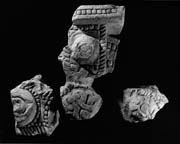
Object type: Part of cross-head, in three pieces
Measurements: a: H. 41 cm (16.1 in); W. 20 cm (7.9 in); D. 21 cm (8.25 in); b: H. 23.5 cm (9.25 in); W. 19 cm (7.5 in); D. 14 cm (5.5 in); c: H. 14 cm (5.5 in); W. 29.5 cm (11.6 in); D. 14 cm (5.5 in)
Stone type: Fine-grained, dolomitic, white to very pale brown (10YR 8/2–8/3) limestone, with small cavities; Lower Magnesian Limestone, Upper Permian; reused Roman ashlar, originally from Tadcaster area (see Fig. 5).
Plate numbers in printed volume: 302-305, 308
Corpus volume reference: Vol 3 p. 97-98
(There may be more views or larger images available for this item. Click on the thumbnail image to view.)
The three pieces can be reassembled in a variety of ways (Tweddle 1987b, fig. 49), but the form of the cross remains constant: straight arms, approximating to type A11, circular arm-pits, and an end consisting of a flat plate surmounted by a hemispherical boss. A plain ring, type 1(a), springs from the sides of the arm.
The more recently discovered pieces carry gesso and red pigment.
A (broad): At the centre of the cross-head is a domed boss carrying a form of ring-knot, comprising an angular circuiting strand threaded through four linked pairs of pattern C loops disposed about a central pellet with a 'pupil'. The strands are plain and flat. The arms each have a variety of domed boss: one, in the upper arm, has a form of simple incised chevron with concentric rings at its centre; in the lateral arms, one has a more complex chevron strip about similar rings, and a third with an outer rim of 'voussoirs'. The one with complex chevrons has a pelleted rim; that with voussoirs, cable. The boss in the upper arm has none. The edge moulding of the arms is bold cable and a row of pellets surmounts the panel by the arm end. A row of pellets decorates the edge and top perimeter of the plate across the arm end, contained in a plain moulding.
B and D (narrow): Plain but finely dressed, with only the stump of the ring and the corner cable moulding as features.
C (broad): This has identical mouldings with face A's. The central boss is lost, but a canine animal (minus its head) crouches, facing the crossing. Its fore legs are spread and its hind legs and tail form a clasping element over a rump, giving a three-dimensional impression.
E (top): Within an outer flat-band and inner pelleted moulding, there is a square panel containing a boss decorated with interlace identical to that on the central boss of face A, except that there were probably only three pairs of loops.
Reconstructions of the fragments abound (Collingwood 1927, 132, fig. 148; Tweddle 1987b, 157, fig. 49). Only the cross-head at Bilton in Ainsty, West Riding (Collingwood 1915, 139, figs. a–c on 140) provides any close parallel for this ambitious monument. The high relief and four-square aspect of the cross are held in common. The plate and bossed ends to the arms, however, are unique, those at Stanwick and Wath, North Riding, not being half so developed (contra Tweddle 1987b, 157). The ring-knots with central pellets point to its Anglo-Scandinavian milieu. They are derived from the Borre-style which was popular in York in the early tenth century. Pellet-runs and cabling are common in York at this period, though rarely as deeply cut. The crouching, three-dimensional dogs are unique and resemble the human figures' function at Bilton. Tweddle (1987) has recently analysed this piece very fully.
