Select a site alphabetically from the choices shown in the box below. Alternatively, browse sculptural examples using the Forward/Back buttons.
Chapters for this volume, along with copies of original in-text images, are available here.


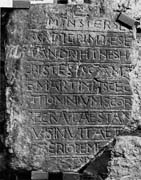
Object type: Dedication stone [1]
Measurements: H. 52.5 cm (20.7 in); W. 38 cm (15 in); D. 12.5 cm (4.9 in)
Stone type: Medium-grained, very pale brown (10YR 7/4) grit, without pebbles; see no. 1.
Plate numbers in printed volume: 312, 321
Corpus volume reference: Vol 3 p. 99-101
(There may be more views or larger images available for this item. Click on the thumbnail image to view.)
Inscription. There is only one carved face, which lacks decorative carving. The inscription is in capitals (Okasha 1971, 131; idem 1983, 111). It is further discussed in Chap. 12 (pp. 46–47).
The inscription was apparently set in a sunken panel like those at Great Edstone 1 and Kirkdale 10. A raised border has been trimmed away along the top and probably down the left-hand side (R.C.H.M. 1981, 33). Okasha (1983, 111) has suggested that 'c. two or three letters are lost from the left-hand side of each line'. More probably the damaged stone down the left edge is the remains of the trimmed-back border. If so, no letters are missing at the beginning of lines three, four, five, and seven. The right-hand side has been broken away. The partially preserved bottom line, the letters of which are smaller than those above, may have been the last line of the text. Deeply incised horizontal guide-lines are set at about 4.7 cm apart. The letters are about 2.5–3 cm high, except in the last line, where the height is about 2 cm. The language of the text starts in Old English and continues in Latin. The last two lines, which are too fragmentary to be read but contain the Old English letter thorn, may have returned to Old English again. It reads:
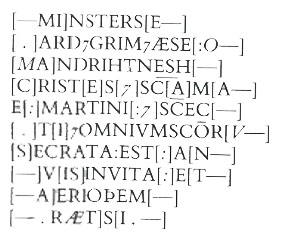
This may be restored as follows: [—] MINSTER SE[TTON —]ARD 7 GRIM 7 ÆSE [:ON NAM]AN DRIHTNES H[—] CRISTES 7 S(AN)C(T)A MA[RIA 7 S(AN)C(T)]E [:] MARTINI : 7 S(AN)C(T)E C[—]TI 7 OMNIVM S(AN)C(T)OR[VM CON]SECRATA : EST [:] AN[—]VIS IN VITA [:] ET[—. It would be possible to suggest alternative word-divisions in the sequence —VISINVITA[:]ET—.
(Translation): '— [—]ard and Grim and Æse built (or founded) [this?] minster in the name of the Lord [. . .] Christ and St Mary and St Martin and St C[uthber?]t and of all the saints. It was consecrated [. . .] in life [eternal?] —'.
The letters are set between deeply incised horizontal lines which were intended to be seen (see Chap. 12, p. 46). The size and placing of the letters were a little uneven. The smaller lettering of the last line implies that the letter-cutter or the designer was running out of space at the end. Parts of one or two letters in lines three and four seem to have been recut into a mortar repair. There is no obvious seriffing but the stone is too worn to be certain.
The letters are in the main Roman capitals. Non-Classical forms include: A with a bar over the top and, in some cases, with an angular cross-bar; square (as well as round) C; round E (as well as square); a rectangular form of the capital G; M with vertical outer strokes; N with the diagonal meeting the verticals short of their ends (as well as the Classical form); and open R. The Old English letter thorn is used in the penultimate line. The Tironian symbol for et is used here for and or ond and et. Mid-line points stand as word-dividers between some words. The nomen sacrum for Latin sanctus, marked by a horizontal abbreviation bar, was used, but Christ's name (in English) appears in full.
==J.H.
Inscription Parallels for the non-Classical letter forms could be found in Anglo-Saxon inscriptions of any time between the eighth and eleventh centuries (Okasha 1968). On the other hand, Tironian et only occurs in Anglo-Saxon inscriptions which are late and in Old English (Okasha 1971, 157).
Patronage, a secular concern, is recorded in Old English, but the details of the dedication lapse into Latin, perhaps influenced by an official ecclesiastical record of the dedication in Latin. The noun in this hypothetical document would have been feminine (perhaps ecclesia or basilica), giving consecrata. As at Kirkdale 10, the church is called a minster. The name of Christ correctly precedes those of the saints, as in the inscriptions at Kirkdale 10, St Mary-le-Wigford in Lincoln, and Milbourne Port in Somerset, all three probably dating from the eleventh century (Higgitt 1979, 369). The AN— in line 7 has been read as a dating formula (anno . . .), (Okasha 1971, 131). This is not certain. It is not clear, for example, how the letters in the following line would relate to this reconstruction. The A could, alternatively, be a introducing the agent (for example, a nobis). The group of letters, INVITAET, is translated 'in the life of –' by Okasha, but this is only one possibility. Amongst other possible readings would be a formula like vita eterna.
The inscription records the names of the founders or building patrons of the church, the saints in whose name it was dedicated, and perhaps also the date of consecration. Its contents can be compared with a handful of other surviving pre-Conquest dedication inscriptions (Higgitt 1979, especially 367–9). The names Grim and perhaps also Aese are of Scandinavian origin (Page 1971, 177–8). Scandinavian names are unlikely in York before the tenth century, whilst the use of Old English and the form of the lettering are unlikely much after the Conquest.
==J.H.
