Select a site alphabetically from the choices shown in the box below. Alternatively, browse sculptural examples using the Forward/Back buttons.
Chapters for this volume, along with copies of original in-text images, are available here.


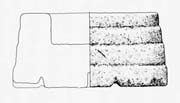
Object type: Architectural feature, reused as cross-base(?)
Measurements: (After Blagg 1987): H. 41 cm (16 in); Diameter 85 cm (33.5 in)
Stone type: Unobtainable
Plate numbers in printed volume: 413-415
Corpus volume reference: Vol 3 p. 117
(There may be more views or larger images available for this item. Click on the thumbnail image to view.)
The base has been formed from an (originally rectangular) Roman stone by rounding off the corners to form a slightly tapering cylinder. The base (originally top) has a central lewis hole, and three cramp holes and a prye-hole (Blagg 1987, 155). There is a square socket in the top. The sides are divided into four plain bands (or fasciae) by incised lines, each band being stepped in slightly from the one below.
Appendix A item (stones dating from Saxo-Norman overlap period or of uncertain date).
The treatment of the sides is demonstrably secondary (Blagg 1987, 155). Moreover, it is unlike that of any known Roman architectural fragments, but does resemble two capitals from the Anglo-Saxon church at Reculver, Kent, and a cylindrical base or capital from Ripon, West Riding (Wenham et al. 1987, 153, pl. XXIX a–b), which may have formed part of the Anglo-Saxon church there. The Ripon stone has no socket, though one of the Reculver capitals apparently did (ibid., 154). The socket of the present piece may therefore be primary; if secondary, it presumably implies reuse as a cross-base. Such reuse may, however, still have taken place in a pre-Conquest context.
