Select a site alphabetically from the choices shown in the box below. Alternatively, browse sculptural examples using the Forward/Back buttons.
Chapters for this volume, along with copies of original in-text images, are available here.


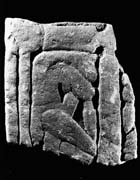
Object type: Part of grave-cover, in two joining pieces
Measurements: a: L. 38.5 cm (15.2 in); W. 33.3 cm (13 in); D. 12.5 cm (4.9 in); b: L. 32 cm (12.6 in); W. 21 cm (8.25 in); D. 11.5 cm (4.5 in)
Stone type: Medium-grained, very pale brown (10YR 7/4) sandstone; probably Millstone Grit, Namurian, Upper Carboniferous; probably reused Roman ashlar, originally from Hetchell Crag (Thorner) or Otley areas (see Fig. 5).
Plate numbers in printed volume: 361-364
Corpus volume reference: Vol 3 p. 111
(There may be more views or larger images available for this item. Click on the thumbnail image to view.)
Both fragments are carved only on their upper faces.
a: The double edge moulding is broad and flat. The lateral arm of a superimposed cross, type A12, intrudes upon the double moulding, but its terminal is broken away. The arm-pits of the cross are deeply drilled. The stem is flat and broad. In the panel below the arm is an inward facing York winged beast. The scroll on the wing is faint, the eye worn away, and the collar just visible. The jowl line is pronounced, as is the pendant 'leaf' motif at the snout.
b: The double flat edge moulding is identical with fragment a's. The lateral arm of the cross intrudes upon it and retains an inward facing animal head terminal with incised circular eyes, scratched jowl line, and a depression between the snout and the cross-arm. In the panel below is an inward facing York winged beast in good state of preservation. The low relief mane, incised eye, and barred collar, are clear, as is the scroll and parallel features of the inclined wing. The front part of this beast survives on fragment a.
This is a classic example of the York Metropolitan School (see Chap. 10) and is virtually identical with Minster 35–8 and St Mary Bishophill Junior 6. All may have come from related templates, certainly the same atelier. The fragments fit together as in Pattison 1973, and not as in Collingwood 1915. The top end of the slab has been cut off along the cross-arms, as in the Clifford Street case, suggesting deliberate modification in their reuse in the eleventh century.
It is possible that the carving may originally have been associated with the parish church of St Olave, adjacent to the abbey. If so, it must pre-date its foundation by earl Siward (ob. 1055), unless that event were in fact a rededication of a church already in existence.
