Select a site alphabetically from the choices shown in the box below. Alternatively, browse sculptural examples using the Forward/Back buttons.
Chapters for this volume, along with copies of original in-text images, are available here.


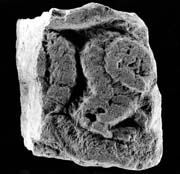
Object type: Fragment of cross-head
Measurements: H. 21.2 cm (8.3 in); W. 21.3 cm (8.3 in); D. 17 cm (6.7 in)
Stone type: Medium-grained, calcareous, very pale brown (10YR 7/3) sandstone; probably Middle Calcareous Grit, Coralline Oolite Formation, Middle Oxfordian, Upper Jurassic; provenance uncertain, but resembles material used at Middleton, Sinnington, and Stonegrave
Plate numbers in printed volume: 323-326
Corpus volume reference: Vol 3 p. 101-102
(There may be more views or larger images available for this item. Click on the thumbnail image to view.)
Perhaps a lateral arm of a cross; there are protuberances which may have been a ring or disk.
A (broad): Plain, flat edge mouldings at top and bottom of the fragment curve, suggesting a cusped profile. Within, the carving is worn but the head and shoulders of a figure with upturned face and long hair may be made out. To its left is a curving band.
B and D (narrow): Broken away.
C (broad): The flat edge moulding indicates a cusped arm with a flat boss within it. The border is echoed by two flat strands following its contour and sweeping around a flat central boss. Some gesso adheres.
The cross form may have resembled St Mary Castlegate 2 with its broad arm-pit and cusp. Here however, there is a little evidence for a disk or plate which would suggest a later date. The basic form is Anglian.
The small portrait head, placed near the centre of the cross, may have gazed upwards at a lost motif. An alternative interpretation is that of a crouching figure like those on the baptismal scenes on the Durham crosses, nos. 5–6 (Cramp 1984, II, pl. 44, 206; pl. 45, 210). [1] Certainly portrait heads on crosses in this position are rare in Yorkshire.
