Select a site alphabetically from the choices shown in the box below. Alternatively, browse sculptural examples using the Forward/Back buttons.
Chapters for this volume, along with copies of original in-text images, are available here.


Object type: Cross-shaft and part of -head [1]
Measurements: H. 66 cm (26 in); W. 26.8 > 18.5 cm (10.5 > 7.25 in); D. 17.2 > 14.7 cm (6.75 > 5.75 in)
Stone type: Medium-grained, slightly micaceous, reddish-yellow (7.5YR 6/6) sandstone; deltaic channel sandstone, Saltwick Formation, Aalenian, Middle Jurassic; perhaps from Aislaby, near Whitby (see Fig. 5)
Plate numbers in printed volume: 578-581
Corpus volume reference: Vol 3 p. 167-168
(There may be more views or larger images available for this item. Click on the thumbnail image to view.)
The shaft has a sharp taper on the broad faces and a tenon cut at the base.
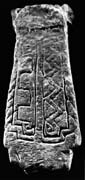
A (broad): The base of the face is plain for a short space. The edge moulding is cabled but becomes plain as it returns across the bottom of the panel in a paired step and joins a plain vertical moulding running up the centre of the face and dividing it into two vertical panels. The left-hand one has an incised battlement pattern, a form of straight line pattern, terminating in a scroll at the base. On the right the panel contains a zig-zag formed from a broad, flat strand, ending in a scroll at the base. The terminals at the top of the panel are worn away. The cross-head expands from the neck but the carving is lost.
B (narrow): The cable mouldings down each side and the stepped base of the panel are as face A, but it lacks the central vertical division and there is an inner roll moulding which turns inwards at the top to form a series of irregular diamond motifs with modelled outlines, each divided down the centre by a roughly vertical bar.
C (broad): The mouldings framing and dividing the panels are as on face A. In the left-hand panel is a vertical run of incised step pattern 1, terminating at the base in a T-shaped motif. In the right-hand one is a run of meander pattern 2, using a broad, flat strand and ending in a scroll. The top of the panel is worn. The lowest arm of the cross is fan-shaped with a double plain border.
D (narrow): The mouldings framing the panel are as on face B, except that the plain stepped section at the base is much broader, and the inner moulding returns across the top of the panel in an arc. Within it is a vertical run of roughly executed straight line pattern using a modelled strand, ending at the base in a scroll. It may be seen as a cross between a meander pattern and a battlement pattern. At the top there were quadrant rings at the corners but these are difficult to decipher.
This is rustic work and need not be late. Its repertoire of meander and straight line patterns can be found on tenth-century monuments. Its form is unusual: it stood in a socket and was very short. The shape of the bottom of the panel is suggested by the tenon.
