Select a site alphabetically from the choices shown in the box below. Alternatively, browse sculptural examples using the Forward/Back buttons.
Chapters for this volume, along with copies of original in-text images, are available here.


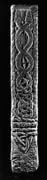
Object type: Upper part of cross-shaft [1]
Measurements: H. 139.7 cm (55 in); W. 21.5 > 21 cm (8.5 > 8.25 in); D. 21.5 > 21 cm (8.5 > 8.25 in)
Stone type: Medium-grained, slightly micaceous, reddish-yellow (7.5YR 6/6) sandstone; deltaic channel sandstone, Saltwick Formation, Aalenian, Middle Jurassic; perhaps from Aislaby, near Whitby (see Fig. 5)
Plate numbers in printed volume: 574-577
Corpus volume reference: Vol 3 p. 167
(There may be more views or larger images available for this item. Click on the thumbnail image to view.)
The cabled moulding of the shaft is returned across the base of each face. Below is a broad, plain, flat moulding, and below that again another cable, running in the opposite direction to the one at the base of the shaft panels. The final element of this band of mouldings is a crudely modelled strand which bifurcates to form a kind of bungled triquetra on three faces. The one on face A is filled with a single pellet, those on faces B and D have three. In the equivalent position on face C is a closed circuit motif based on four-strand plain plait using median-incised strands and with pellets in the interstices.
A (broad): At the top of the panel is a pair of snakes, viewed from above, their undulating, tapering bodies interlacing in a simple twist. The tails are narrowed to a filiform appearance, one terminating in a volute, the other with a trefoil. The heads have pointed ears and drilled eyes. Three pellet fillers lie by the heads and within the two medallions formed by their bodies is what may have been a straight-line pattern or interlace motif, and a raised cruciform element. Below is a closed circuit motif consisting of a short run of four-strand plain plait with median-incised strands.
B (narrow): The panel contains two parallel vertical rows of ornament: on the left, meander pattern 2 (G.I., fig. 27) terminating in a simple twist at the bottom, and, on the right, meander pattern 1, appearing to change to a step pattern just below the break.
C (broad): The panel is filled with a three-strand plain plait, in stopped-plait technique, with median-incised strands, interspersed with pellets.
D (narrow): The panel contains debased and highly irregular plait using flat strands.
This very closely resembles Sherburn 4 in the East Riding (Ills. 772–5), demonstrating contact or itinerant activity across the Vale of Pickering. Both are probably by the same hand.
The repertoire of ornament is largely Anglo-Scandinavian but the straight line patterns, and the pellets tend to be more common in Allertonshire, North Riding, than in Ryedale. The encircling band and pendant triquetrae point to the shaft's response to the fashion for round-shaft derivatives (see Chap. 8). The cables are close to skeuomorphs of rope lashing for a timber pole, as at Beckermet St Bridget 1–2 in Cumberland (Bailey and Cramp 1988, ill. 41), and the triquetra is a formalized Van Dyke, or metal appliqué: compare Bywell 1A in Northumberland (Cramp 1984, II, pl. 162, 853, 855). Adjacent vertical runs of formal pattern are found on Pickering 2D (Ill. 758), and at Aberford in the West Riding. It is not a common local habit.
