Select a site alphabetically from the choices shown in the box below. Alternatively, browse sculptural examples using the Forward/Back buttons.
Chapters for this volume, along with copies of original in-text images, are available here.


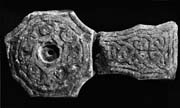
Object type: Part of cross-head, in two joining pieces [1]
Measurements: H. 22.8 cm (9 in); W. 40.7 cm (16 in); D. 8.4 cm (3.25 in)
Stone type: Medium-grained, slightly micaceous, reddish-yellow (7.5YR 6/6) sandstone; deltaic channel sandstone, Saltwick Formation, Aalenian, Middle Jurassic; perhaps from Aislaby, near Whitby (see Fig. 5)
Plate numbers in printed volume: 582-586
Corpus volume reference: Vol 3 p. 169
(There may be more views or larger images available for this item. Click on the thumbnail image to view.)
The cross-arm is of type D9, with widely curved arm-pits.
A (broad): The perimeter moulding is flat and double, the inner strand interrupted by the central roundel. Within the arm is another flat band which splits to accommodate two pellets in the terminal of the arm and also to join the roundel at its other end. The roundel has a flat plain rim and contains a radial marigold design springing from a smaller ring which encircles a central depression. The edge of this recess is chipped at one point.
B and D (narrow): Plain.
C (broad): The arm has a double plain moulding on the perimeter. It contains open, neat interlace, using a modelled, flat strand. The element nearest the cross-head has been broken away, but a short glide remains, dividing it from a pattern F loop and, in the arm-terminal, a register of complete pattern C, with cross-joined terminals.
The single edge moulding at the centre of the cross is broad and flat. At the centre is a circular depression with a flat rim and a smaller flat circular depression or rivet hole at the centre. Between these is a circlet of interlace using a modelled, flat strand. It consists of six units of half pattern A, separated by glides.
E (top) and F (bottom): Plain.
This is a neat and accomplished monument which originally had settings in the centre of each roundel. The rivet hole of face C, and the chip where it was prized out on face A, suggest an association with metalworking. The marigold motif is found on the plaque at Middleton (no. 9; Ill. 694) as well as on the York Minster stele (no. 19; Ill. 82). This is a motif found in Gaul, for example, on the Poitiers baptistery, but not in Hiberno-Saxon art. Different forms of the marigold are common at Hexham, Northumberland (Cramp 1984, II, pls. 172, 910; pl. 178, 944; pl. 182, 972). The interlace patterns, especially the glide and the nature of the strand, display a connection with Ripon, West Riding, rather than the nearer monuments at Kirkbymoorside 6 (Ill. 536), and Filey 1 (Ill. 450) (Adcock 1974, I, 130–1).
