Select a site alphabetically from the choices shown in the box below. Alternatively, browse sculptural examples using the Forward/Back buttons.
Chapters for this volume, along with copies of original in-text images, are available here.


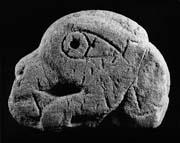
Object type: Part of chair, in two non-adjacent pieces [1]
Measurements:
a: H. 19 cm (7.5 in); W. 22.5 cm (9 in); D. 10 cm (4 in);
b: H. 28 cm (11 in); W. 27 cm (10.6 in); D. 10 cm (4 in)
Stone type: Medium-grained, slightly micaceous, reddish-yellow (7.5YR 6/6) sandstone; deltaic channel sandstone, Saltwick Formation, Aalenian, Middle Jurassic; perhaps from Aislaby, near Whitby (see Fig. 5)
Plate numbers in printed volume: 614-617, 623-626
Corpus volume reference: Vol 3 p. 172-173
(There may be more views or larger images available for this item. Click on the thumbnail image to view.)
A (broad): Fragment a consists of a three-dimensional but flat animal head with projecting jaws. The brow is high and domed, and contains a deeply incised eye, round at the front and tapered to a point at the back. The pupil is deeply drilled within a circular iris. The tip of the upper jaw is lost but a large fang descends immediately in front of a small fang rising from the lower jaw. On the lower cheek and neck there are short incised lines made with a series of punch-holes.
On fragment b, the right-hand edge is vertical and has a recessed groove, 3 cm wide, serving as a rebate. The inclined edge has a plain outer moulding, 1.3 cm wide, flanking a curving strip of incised interlace: parts of two registers of a half pattern, probably pattern A, with long glides. The interlace lies on a slightly recessed surface.
B (narrow): The top and first narrow side of fragment a make up the back of the chair finial. On the top of the animal's head is a raised leaf motif, 10 cm long, with a sharply pointed tip and a bilobate base. There is a thinly incised central vein to the leaf. The tip of another identical leaf fits against the lower end of the element. The vertical narrow side of fragment b carries a run of two and a half adjacent leaf motifs, each 10 cm long, with pointed tip and bilobate base. A thinly incised central axial vein is given to each leaf. This is flanked on each side by a plain, flat moulding, 1.5 cm wide.
C (broad): On fragment a, this face is identical with face A, except for deeper cutting on the incised eye and a low step where the jowl met the brow. More of the jaws are missing on this face. There is a chip by the drilled pupil. The left-hand edge of fragment b has a plain moulding, 1.3 cm wide, next to a wider flat groove, 3 cm wide. Within it is a curving strip of incised interlace: one register and part of a second of alternating half pattern B, with long glides. Whilst the outer edge is straight and inclined, the inner edge of the interlace strip, which is recessed, has a long, gentle curve.
D (narrow): Broken away on fragment a, on fragment b this narrow edge is inclined. At each side is a plain moulding, 2.5 cm wide. Within is a simple scroll with very worn nodes and small rounded berry bunches.
By relating the two fragments (Hartley 1985, 12), the vertical slab of a composite stone chair may be reconstructed. The thickness of the terminal head and of the tapering piece correspond exactly, and the edge ornament of pointed leaves adorns both fragments, each motif element being the same length, 10 cm. The lines of each edge of the tapering section show that it was not a shaft, and the stone's form may be compared with the chair-arm which survives at Bamburgh, Northumberland (Cramp 1984, I, 162–3, fig. 18; Lang 1983, 178, pl. LXXV, b) and Monkwearmouth 16, co. Durham (Cramp 1984, I, 130, II, pl. 124, 673–6).
The rebate and grooves suggest a tongue-and-groove technique of construction which is associated with composite box shrines of the period, but since there is a rebate on both faces, as well as ornament, it is possible that originally the piece served as an upright element on a stone bench, i.e., an adjacent seat is implied by the rebates. The back of the chair, however, cannot have been a wall, by the same argument.
The animal-head terminal is a feature of seats depicted in manuscripts of the early eighth century; the best parallel for the Lastingham head is the throne of David in the Durham Cassiodorus, MS B II 30, fol. 81v (Ill. 917). Wall (1906, 159) considered it to be 'The terminal of one of the arms to a stone seat of dignity', but regarded it (presumably like Collingwood) as post-Conquest.
The linear leaf pattern on face B is very reminiscent of the motif on the horizontal element of the 'tympanum' over the portrait of St John the Evangelist in the Canterbury Codex Aureus (fol. 150v.). The organization of the leaves and their shape are identical (Nordenfalk 1977, 104–5, pl. 37).
The tip of the snout may well have curled upwards, as it does in manuscript depictions. Judging from the fracture, the neck of the side slab was no slimmer than the base of the terminal head, and by using the 10 cm leaf elements as a regular recurring pattern along with the extensions of the tapering edges, it is possible to postulate that the original height of the chair-arm was approximately 72 cm. The angle of the terminal head, again judging from the fracture, was tipped forwards slightly so that the lowermost leaf element surviving on the head was vertical and in line with the straight edge of the lower fragment. The lost Lastingham fragment (no. 11) may be another such chair fragment. A later depiction of a zoomorphic chair terminal may be seen on Old Malton 1 (Ill. 736).
