Select a site alphabetically from the choices shown in the box below. Alternatively, browse sculptural examples using the Forward/Back buttons.
Chapters for this volume, along with copies of original in-text images, are available here.


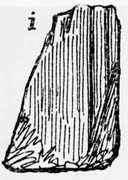
Object type: Fragment [1]
Measurements: (after Collingwood 1907): H. 21.6 cm (8.5 in); W. Unobtainable; D. 10.8 cm (4.25 in)
Stone type: Unobtainable
Plate numbers in printed volume: 618-621
Corpus volume reference: Vol 3 p. 173
(There may be more views or larger images available for this item. Click on the thumbnail image to view.)
Only three sides have been recorded.
A (broad): Two plain, flat mouldings of equal width survive at the right-hand edge. The rest is plain.
B (narrow): The narrow edge has a flat, plain edge moulding flanking a stringy run of interlace, consisting of three or two-and-a-half registers of half pattern A, Collingwood's drawing (Ill. 619) showing half a register less than Wall's (Ill. 621). It was apparently carved in high relief.
C (broad): The other broad face is identical with face A, except that the mouldings run down the left-hand side, and the outer one is broader than the inner.
D (narrow): Broken away, to judge from the profiles of the adjacent faces.
The fragment is possibly from a plain shaft but more likely from a chair, like no. 10. The interlace pattern is controlled and pre-Viking.
