Select a site alphabetically from the choices shown in the box below. Alternatively, browse sculptural examples using the Forward/Back buttons.
Chapters for this volume, along with copies of original in-text images, are available here.


Object type: Part of cross-arm
Measurements: Unobtainable
Stone type: Limestone, Middle Eocene, non-British (Peers 1927b, 253)
Plate numbers in printed volume: Fig. 31; Ill. 121
Corpus volume reference: Vol 4 p. 162
(There may be more views or larger images available for this item. Click on the thumbnail image to view.)
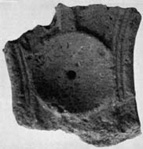
Part of the arm of a cross-head, having concave sides, but roughly broken at each end.
A (broad): Along each edge is a triple roll moulding, of which the outer moulding is the most prominent. These overlap the edge of a dished disc with a central drilled hole. A plain moulding of square section runs from the edge of the disc off the lower edge of the fragment.
Part of a free-armed cross-head of type A9 or 10. The disc and moulding on face A suggest it was of the 'lorgnette' or 'spine and boss' type, where the principal face was decorated with five discs or bosses, one in the centre and one on each arm, linked by plain mouldings (Collingwood 1927, 94–8). The deeply drilled hole in the centre of the dished boss at Reculver may, as Peers suggested, have been intended to take a metal fitting (Peers 1927b, 253). There is evidence on other fragments from Reculver of this practice, on 1e for example, but it is difficult to envisage what sort of fitting would be appropriate to the centre of a dished disc. It is possible that the drilled hole was merely intended to give emphasis to the centre of the disc.
It is unclear whether this cross-head formed part of the monument represented by Reculver 1a–e and probably also Canterbury Old Dover Road 1, or an entirely different monument. There is nothing in the decoration to link the cross-head with the other stones, although they must be of broadly the same date. The only link is provided by the stone type. The cross-head was identified in 1927 as of a non-British limestone, probably from France, and recent work on the other fragments has demonstrated that they are made of a northern French limestone. As a fact, this is suggestive, but not conclusive. It may be that there was abundant stone of this type at Reculver available for reuse from the ruined Roman buildings.
