Select a site alphabetically from the choices shown in the box below. Alternatively, browse sculptural examples using the Forward/Back buttons.
Chapters for this volume, along with copies of original in-text images, are available here.


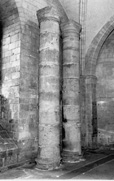
Object type: Two columns
Measurements: H. 490 cm (193 in); Diameter of bases 69 cm (27.2 in)
Stone type: Pale grey, oolitic limestone;Marquise stone, Oolithe de Marquise Formation, Bathonian, Middle Jurassic; Boulonnais, France
Plate numbers in printed volume: Ills. 123-138
Corpus volume reference: Vol 4 p. 162-163
(There may be more views or larger images available for this item. Click on the thumbnail image to view.)
The drawings of the columns in situ, before Reculver church was demolished, demonstrate their function, which was to support the triple arcade between the nave and chancel (Ills. 124–5, 127). The use of triple arcades in this position occurs elsewhere among the early Kentish churches at St Pancras's, Canterbury, where columns were also used (Ills. 59–60), and Rochester, although there the evidence is tenuous. Outside Kent a similar arrangement may be inferred from the surviving fabric at Bradwell-juxta-mare, Essex. Both at Rochester and Bradwell there is so little surviving evidence that it is unclear whether either piers or columns were used. Apart from the columns under discussion and the column base from Canterbury (St Pancras) no. 1, the only free-standing columns from the pre-Conquest period in south-east England are those that may be inferred from the surviving capitals at Canterbury (St Augustine's Abbey) nos. 5 –7; Ills. 29–40.
Blagg has pointed out that the best parallels for both the capitals and bases at Reculver lie in east Mediterranean material of the fifth and sixth century (Blagg 1981, 52–3). This implies that the pieces must belong to a post-Roman context and are not directly reused Roman material. Within the corpus of Anglo-Saxon sculpture, the only parallels for the form of the capitals are provided by an undated capital from Betchworth, Surrey (Ill. 2), a capital from Ripon, possibly from St Wilfrid's church (Taylor and Taylor 1965–78, ii, 517), and two bases or capitals from St Mary, Castlegate, York, reused in an eleventh-century context (Wenham et al. 1987, 153–5, fig. 47; Lang 1991, 117, ills. 413–15).
