Select a site alphabetically from the choices shown in the box below. Alternatively, browse sculptural examples using the Forward/Back buttons.
Chapters for this volume, along with copies of original in-text images, are available here.


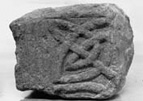
Object type: Fragment of cross-shaft(?)
Measurements: H. 16 cm (6.3 in); W. 22 cm (8.7 in); D. 12 cm (4.7 in)
Stone type: Pale brownish-yellow, oolitic limestone, unevenly graded fine to coarse, with scattered limonitic pellets and shell fragments; of uncertain provenance; has some resemblance lithologically to Canterbury St Augustine's 9
Plate numbers in printed volume: Ills. 141-142
Corpus volume reference: Vol 4 p. 164-165
(There may be more views or larger images available for this item. Click on the thumbnail image to view.)
The fragment is of sub-rectangular section. It is vertically dressed to the left but roughly broken above, below, to the right, and on the back.
A (broad): Along the left-hand edge are five parallel roll mouldings (the outer one heavily damaged). Along the upper edge is part of a similar moulding cut away by the break. The face is decorated with approximately one quarter of a complex geometrical interlace, apparently surrounded pattern D with included U-bend terminals.
B–D: Broken away.
Although this piece is very small, and all the faces except one have either been roughly broken, or dressed flat, the nature of the decoration, with a plain border containing interlace, corresponds to that seen on other cross-shafts from south-east England. Close parallels are provided by the shafts from Barking, Essex (no. 1; Ills. 256 - 9), and Kingston upon Thames, Surrey (Ills. 95 - 6).
The only evidence on which to base the dating of the piece is the interlace. This has been reconstructed as an encircled pattern with bifurcating strands (Harrison and Williams, 1979, 34 - 5, fig. 7), but the pattern can be reconstructed more convincingly without these features. Whatever its precise reconstruction, the fine strand of the interlace and well worked-out nature of the pattern can best be compared with that on Reculver 1e (Ills. 119 - 20) and a similar, ninth-century date can be tentatively suggested.
