Select a site alphabetically from the choices shown in the box below. Alternatively, browse sculptural examples using the Forward/Back buttons.
Chapters for this volume, along with copies of original in-text images, are available here.


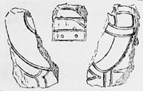
Object type: Fragment of grave-marker
Measurements: H. 15 cm (5.9 in); W. 9 cm (3.5 in); D. 8 cm (3.2 in)
Stone type: Unobtainable
Plate numbers in printed volume: Ills. 143-145
Corpus volume reference: Vol 4 p. 165-166
(There may be more views or larger images available for this item. Click on the thumbnail image to view.)
Since the description of this piece relies entirely on a drawing, it is impossible to be certain of the relationship of the edge with the runic inscription to the other two faces, or of which way up they were originally meant to be seen. Ills. 143–5 are placed as in Livett 1889, and all locational terms should be understood as referring to these.
The carving is small, sub-rectangular, and tapers slightly to the left. One edge is vertically dressed, and the remaining edges are roughly broken.
A (broad): A pair of incised lines curves down in parallel from the upper left to the lower right, and is paralleled below by a third incised line bifurcating at its lower end. The bifurcations, paralleled by a second pair of incised lines, curve backwards.
B (narrow): Inscription The edge of the fragment as depicted in the drawing bears what appear to be runic characters. Though they might be Anglo-Saxon, the likelihood is that they are Scandinavian, given the nature of the decoration on faces A and C. The runes, if that is indeed what they are, run up or down the edge. They are transliterated below from top to bottom of Ill. 144, with the tops of the characters assumed to lie to the right. Two characters and a divider are visible, and parts of two further characters.
[.]ki:[.]
The third rune is furnished with a dot on the left of its upper part. This might indicate a dotted i (then probably with the value [e] or [æ]), but the diacritic was normally placed much closer to the middle of the rune and, in carefully executed inscriptions at least, centrally on the incision. The likelihood must be that what is depicted here is a chance mark.
C (broad): A band defined by parallel incised lines curves down from the upper right to the lower left. It is crossed at right angles by narrower curving bands near the top and at the bottom; the latter forms one element of a bifurcation which, to the right of the junction, is itself crossed by a pair of transverse incised lines.
D (narrow): Broken away.
The occurrence of decoration on opposite faces suggests that the piece stood upright; the probable inscription on the edge is in exactly the same position as that on the grave-marker from St Paul's in London (Ill. 350), and also seems to employ runes. It is, therefore, highly likely that this is also a grave-marker. The ornament on faces A and C appear to be fragments of tendril decoration consistent with the Scandinavian Ringerike style, although, admittedly, very little of the decoration survives. These traces of ornament and the other analogies with the St Paul's stone in London point to a date in the reign of Cnut (1016–42); the possible epigraphic evidence, though slight, is not inconsistent with this (see below). For the possible context of this piece, see Rochester Cathedral no. 3.
Inscription The (apparent) inscription is too fragmentary to be edited into a text and translated, and it is impossible, on the basis of what the drawing shows, even to hazard a guess as to dating and provenance. On the assumption that the inscription was made in or near Rochester, however, and that it is Scandinavian, one would think the first half of the eleventh century a likely period.
