Select a site alphabetically from the choices shown in the box below. Alternatively, browse sculptural examples using the Forward/Back buttons.
Chapters for this volume, along with copies of original in-text images, are available here.


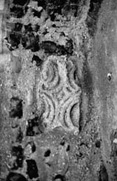
Object type: Fragment of cross-shaft
Measurements: H. 18 cm (7 in) (W. 29 cm (11.4 in); D. Built in
Stone type: Light grey (with a brownish tinge), medium-grained, shelly, oolitic limestone; Barnack stone, Lincolnshire Limestone Formation, Inferior Oolite Group, Middle Jurassic
Plate numbers in printed volume: Ill. 371
Corpus volume reference: Vol 4 p. 235-236
(There may be more views or larger images available for this item. Click on the thumbnail image to view.)
The decoration of this fragment is so closely related to that of Saffron Walden no. 2 that it seems likely that they were part of the same cross-shaft.
The decoration of these pieces and that of the grave-cover from Oxford Cathedral (Ill. 362) are closely related. The latter probably dates to the mid eleventh century, and a similar date is possible for the Saffron Walden fragments. The nature of the decoration provides some support for this dating. Nested geometrical shapes are used on a number of east midlands grave-covers which Butler dates to the eleventh century, such as the examples from Waterbeach and Wood Walton, Cambridgeshire (Butler 1956, 90, figs. 1.1–1.2).
