Volume 4: South-East England
Select a site alphabetically from the choices shown in the box below. Alternatively, browse sculptural examples using the Forward/Back buttons.
Chapters for this volume, along with copies of original in-text images, are available here.
Current Display: Romsey 02, Hampshire


Overview
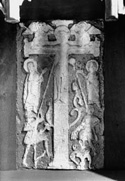
Object type: Crucifixion panel [1]
Measurements: H. 74 cm (29 in); W. 44.5 cm (17.5 in) Built in
Stone type: Pale yellow, fine-grained limestone, with signs of cavernous weathering; Caen Stone, Calcaire de Caen Formation, Bathonian, Middle Jurassic; Caen, Normandy
Plate numbers in printed volume: Ills. 453, 455
Corpus volume reference: Vol 4 p. 261-263
(There may be more views or larger images available for this item. Click on the thumbnail image to view.)
Present Location
Built into the reredos of the altar of the chapel of St Anne, at the east end of the south choir aisle
Evidence for Discovery
Unidentified account of 1742 records that panel then 'stood by itself behind the communion table on the south wall' (Liveing 1906); apparently later lost and rediscovered by the Rev. E. L. Berthon (vicar 1860-92) built face-inwards into walling of chapel of St Mary in retro-choir (i.e. presumably in blocking of arch to former Lady Chapel)
Church Dedication
abbey, St Mary
Present Condition
Good
Description
On a narrow rectangular panel (the upper and lower edges being the shorter) is a low-relief cross standing on a double-stepped base which in turn rests on the lower edge of the panel. The head of the cross and each of the horizontal arms terminates in a narrow cross piece, that of the head touching the upper edge of the panel. The nimbed figure of Christ is frontally placed, with the arms stretched out horizontally, and the legs straight and reaching barely half-way down the lower limb of the cross. The feet are out-turned. To the left of the head of the cross is a frontally-placed, one-third length angel which is nimbed and robed, with drilled eyes and an incised mouth. The left hand is raised, palm-outwards, towards the head of Christ, and in its right hand is a sceptre held at an angle. Its wings are spread. To the right is a similar angel, a mirror image of the first, except that its facial features and the tip of the sceptre are lost. On the lower edge of the panel, to the left, stands a figure with its left leg raised and bent at the knee. The figure wears a knee-length garment, and holds in both hands a long-stemmed spear, the point of which touches the chest of Christ. To the right is a similar figure holding in its left hand a long pole with a circular sponge on the end which touches the lower limb of the cross at the level of Christ's waist. In the figure's right hand is a cloth. Above the figure to the left the robed and nimbed figure of the Virgin is half-turned towards the cross, with her left hand raised, palm outwards. She wears a long robe reaching to the ankles, a cloak, and a head covering. In the corresponding position to the right the robed and nimbed figure of St John has a similar attitude. From the stem of the cross, at the level of the waists of the lower flanking figures, develop plant sprays. That to the left has a fleshy, upturned leaf with a lobed end, and a similar, smaller leaf curving down to touch the thigh of the flanking figure. To the right an undulating stem, having two subsidiary downward-curling stems, flanks the cross, terminating in a triangular leaf on the level of the waist of St John. From the lower edge of the panel, to the right, below the right foot of the lower figure, develops a bulbous plant stem which divides into two fleshy backward-curling leaves. From the lower edge of the panel, to the left, develops a plant stem which rises vertically to touch the figure, and having a subsidiary leaf developing to the right.
Discussion
The function of this panel is difficult to establish, but, like the closely-related panel from Stepney in London, it must stand in some sort of relationship to the large-scale crucifixion groups also encountered in south-east England, such as no. 1 from this site, Langford 1–2 in Oxfordshire, and Breamore 1 and Headbourne Worthy 1 in Hampshire. Outside the area of the present study there are similar crucifixion panels at Daglingworth, Gloucestershire (Taylor and Taylor 1966, 15–16), Hexham, Northumberland (ibid., 16); Marton, Lincolnshire (ibid., 16), Westow, Yorkshire (ibid., 17–18, fig. 6), and Wormington, Gloucestershire (ibid., 13–14, fig. 5). All of these panels are ex situ, so their original functions are difficult to assess, but it has been suggested that they originally formed part of the interior fittings of the church, and were, perhaps, used in conjunction with the altars (Taylor and Taylor 1965–78, iii, 1056; Taylor 1975, 167–8).
As noted in Chap. V, the acanthus sprays employed on the panel find their best parallels in works of the early tenth century, such as the St Cuthbert stole of c. 909–16 (Battiscombe 1956, pl. XXXIV) and the Aethelstan Psalter (Temple 1976, no. 5, ill. 33) traditionally associated with the reign of king Aethelstan, 924–39. There are, however, features pointing to an earlier date, notably the round staring eyes of the figures and the flat, linear treatment of the drapery, feature paralleled in west midland styles of the ninth century (Cramp 1972, 146).
Date
Ninth century
References
Yarborough 1898 - 1903, 228; Doubleday and Page 1903, 238, pl. facing 238; Liveing 1906, 36, pl. facing; Mason 1907, 260; Perkins 1907, 56 - 9, pl. facing 56; Dalton 1908, 229; Page 1911, 467; Prior and Gardner 1912, 137; Thompson 1924, 337; Cottrill 1931, 52 - 3, appendix; Casson 1933, 26; Rice 1947, 11; Cox and Jowitt 1949, 142, pl. facing 148; Kendrick 1949, 48, pl. XL.3; Green and Green 1951, 34 - 5, 53, pl. XA; Rice 1952, 108, pl. 18b; Stone 1955, 40; Fisher 1959, 89; Fisher 1962, 393; Taylor and Taylor 1965 - 78, ii, 522; Radford 1966c, 220; Taylor and Taylor 1966, 12 - 13; Pevsner and Lloyd 1967, 485, pl. 8; Cramp 1972, 146, taf. 69.1; Cramp 1975, 198; Coatsworth 1979, i, 278 - 81, ii, 41, pl. 140; Tweddle 1983b, 28; Tweddle 1986b, i, 75 - 6, 155 - 6, ii, 451 - 3, iii, pl. 81b
D.T.
Endnotes