Select a site alphabetically from the choices shown in the box below. Alternatively, browse sculptural examples using the Forward/Back buttons.
Chapters for this volume, along with copies of original in-text images, are available here.


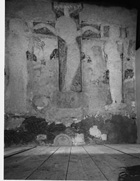
Object type: Crucifixion [1]
Measurements: H. c. 155 cm (61 in). Other measurements unobtainable; D. Built in
Stone type: Pale greyish-yellow to yellowish-orange, oolitic limestone; probably Combe Down Oolite, Great Oolite Formation of the Bath area, Great Oolite Group, Middle Jurassic
Plate numbers in printed volume: Ills. 425-428
Corpus volume reference: Vol 4 p. 251-253
(There may be more views or larger images available for this item. Click on the thumbnail image to view.)
This is a Crucifixion scene with the Virgin and St John. The cross is composed of four stones, two forming the broad vertical limb, and two others the narrower horizontal limbs. Along the left- and right-hand edges of the vertical limb, and along the upper and lower edges of the horizontal limbs, are borders decorated with three vertical mouldings. The outline of the figure of Christ can be discerned against a painted background, but is cut back flush with the wall. He is nimbed, and bent at the waist, the torso sloping to the right and the legs to the left. The arms slope upwards, and the hands hang down from the wrists. There is a dowel hole above each wrist, and another dowel hole at either side of the position of Christ's head. In the western hole is a wooden peg with copper alloy staining. Above Christ's head the mutilated Hand of God develops from a cloud carved at the upper end of the stone forming the head of the cross. The cloud is composed of three undulating incised lines. A pair of incised, undulating lines curves down from the ends of the moulding behind the Hand of God.
Beyond the end of each horizontal arm of the cross is a rectangular panel, carved from the same piece of stone. Each is decorated with a mutilated disc within a border. Below that to the left, carved on two separate stones which parallel the lower limb of the cross, and extends beyond its foot, is the mutilated, inward-facing, robed and nimbed figure of the Virgin contained within a frame. In the corresponding position to the right, again carved on two stones, is the mutilated figure of St John, bent slightly forward at the waist; he is standing on a ground surface against which the border stops on either side.
Traces of original paint survive in a number of areas (Rodwell and Rouse 1984, 321ndash;2; Rodwell 1990, 164): the cloud is primed with white, overpainted in bright red, with a fragment of gold leaf. The recessed field behind the Christ figure is primed white, and the moulded border is red, without priming. A fragment of original red survives between Christ's head and halo. The recessed field behind the Sun is again primed white, and the moulded border is deep red without priming, the paint turning into the joint above St Mary's head. There is also a fragment of red between her halo and head. The recessed field behind St John is primed white.
Green and Green (1951, 38) have suggested that it was removed from its original position, possibly over the chancel arch, and set up here when the church was enlarged in the fifteenth century, and that at the same time the porch was raised to form a chapel. This was based on the belief that the arms of the cross had been reversed. Recent work by Rodwell and Rouse has confirmed that the crucifixion is ex situ, but that the arms have not been reversed (Rodwell and Rouse 1984, 308, 311–12). The conclusion that the crucifixion group is ex situ derives from the fact that some stones are replacements, or missing completely. For example, the stone now forming the lower end of the vertical limb of the cross is not original, although there was an originally a stone in this position, and there must have been another stone on either side of the head of the cross, forming a larger cloud from which the Manus Dei develops. In addition many of the stones have their edges damaged and made-up in plaster in a manner suggestive of removal from another position. Also in a number of places, the original paint on the borders runs onto the edges of the stones into places which it could not have reached if the paint was applied in their present situation. Most notably, there is paint on the edge of the stone bearing the Sun actually in the joint between it and the stone bearing the figure of St Mary.
The original positioning of the crucifixion group remains problematical. Rodwell and Rouse have pointed out that as it shows no sign of weathering, it must have come from one of three positions: inside the demolished western chamber over the west doorway; over the nave arch; or over the chancel arch (Rodwell and Rouse 1984, 315–17). They have pointed out that, although both the nave and chancel arch were rebuilt in the fifteenth century, they were widened, but they were not raised significantly in height, so there was no need to remove any feature which survived above the pre-Conquest arches. Nor does the walling in these positions show any sign of disturbance. It seems likely, therefore, that the crucifixion group was placed over the west doorway inside the western chamber, as at Headbourne Worthy 1. The western chamber appears to have been demolished in the fifteenth century, and the west wall of the church rebuilt, virtually obliterating traces of the original west door. This operation would certainly have necessitated the removal of the crucifixion group.
Rodwell has interpreted the two dowel holes on either side of Christ's head as fixing points for a metal crown. Clearly they are points of attachments for some sort of metal fitting, that it was a crown seems unlikely. Christ's head has been cut away, but from the disposition of his body it is likely that his head lay at c. 50 degrees to the horizontal, and probably tilted forward. The dowel holes, however, lie on the horizontal, that is, they do not relate to the position of the head. Moreover, at Romsey 1, where the head of Christ survives intact and also wore a metal crown, it is the head itself which is flattened to allow a crown simply to be crimped in place (Ill. 456). Perhaps the dowel holes held a gilded appliqué which formed part of the nimbus. A distant parallel for such a feature is provided by a fragment of a wooden Christ-figure from Jelling, Denmark, where the presence of a metal nimbus has also been suggested (Marxen and Moltke 1981, 274). Dowel holes above the position of each wrist of the figure of Christ at Breamore have been interpreted by Rodwell as the attachment points for metal strips representing bindings around the cross.
The metal fittings clearly constituted only one element of a rich colour scheme which also involved paint and gilding. From the surviving traces of paint, it can be suggested that the borders to the fields were painted deep red, without priming, and the recessed backgrounds white. Traces of original red paint, without priming, survive between the head and halo of Christ and St Mary. The cloud from which the Manus Dei issues was primed white, then painted deep red, and was at least partially gilded.
