Select a site alphabetically from the choices shown in the box below. Alternatively, browse sculptural examples using the Forward/Back buttons.
Chapters for this volume, along with copies of original in-text images, are available here.


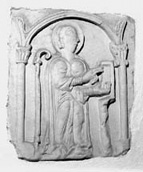
Object type: Figural panel [1]
Measurements: H. 51 cm (20 in); W. 43 cm (17 in); D. Built in
Stone type: Whitish-grey, fine-grained limestone; Caen stone, Calcaire de Caen Formation, Bathonian, Middle Jurassic; Caen, Normandy
Plate numbers in printed volume: Ill. 181
Corpus volume reference: Vol 4 p. 178-179
(There may be more views or larger images available for this item. Click on the thumbnail image to view.)
The identification of the figure presents a number of problems. The figure is tonsured and has to the left a crozier and to the right a reading desk. It must, therefore, represent a monk who was also a bishop and possibly an author. Unfortunately, there is no comparable figure in stone, metalwork, or ivory from southern England, and it is necessary to turn to the manuscripts for comparative iconography. These depict five possible candidates: St Gregory; St Benedict; St Aldhelm; St Dunstan; and St Aethelwold.
St Dunstan and St Aethelwold are depicted twice in pre-Conquest manuscripts, in BL MS Cotton Tiberius A. III, fol. 2v (Temple 1976, no. 100, 118–19, ill. 313), and in a copy of it, Durham Cathedral Library MS B. III. 32, fol. 56v (ibid., no. 101, 119, ill. 315). In both scenes the two figures occur seated together, each holding a Tau-shaped crozier and an opened scroll. St Dunstan wears the pallium. The only point of resemblance with the Sompting figure is in the form of St Dunstan's tonsure where the front and top of the head are bald and the hair is gathered at the back of the head: precisely the arrangement seen at Sompting. This feature is not confined to depictions of St Dunstan, however. The figure of St Aldhelm in Lambeth Palace Library MS 200, fol. 68v, has a similar tonsure (ibid., no. 39, 62–3, ill. 132). In contrast, the drawings of St Aldhelm in the Bodleian Library, Oxford, MS Bodley 577, fols. 1r, 1v (ibid., no. 57, 75–6, ills. 179–80) show the saint with a normal tonsure. On fol. 1r he has a lectern to the right as on no. 13, but on fol. 1v he is standing, facing right and presenting his book (De Virginitate) to the nuns of Barking. In neither case is the figure accompanied by a crozier.
St Benedict is depicted three times in pre-Conquest manuscripts, in BL MS Arundel 155, fol. 133v (Temple 1976, no. 66, 84–5, ill. 213); BL MS Cotton Tiberius A. III, fol. 117v (ibid., no. 100, 118–19, ill. 314); and in Orléans, Bibl. Mun. MS 175, fol. 149r (ibid., no. 43, 66, ill. 144). In Arundel 155 and Tiberius A. III the figure is seated, has the figure of a monk at his feet and is tonsured; in the former he holds a crozier. In Tiberius A. III there is a lectern to the right of the saint, but in Arundel 155 a manuscript of his rule is presented to him by a monk. In the Orléans manuscript the saint is standing and facing left and tonsured in the same way as the Sompting figure, but there is no crozier or reading desk. The three depictions of St Benedict between them, therefore, cover all of the iconographic features encountered at Sompting, although no individual representation provides an adequate parallel in itself.
The same situation is encountered in the two pre-Conquest depictions of St Gregory. In the Orléans manuscript, fol. 149r (Temple 1976, no. 43, ill. 144), the saint is tonsured, standing, and facing right. He holds a crozier and an open book in his left hand and at his feet is a monk. In Oxford, Bodleian Library MS Tanner 3, fol. 1v (ibid., no. 89, 105–6, ill. 298), the saint is seated and has a book on a reading stand to the right. The figure may originally have been tonsured, but in a twelfth-century overpainting a mitre and crozier have been added.
In Anglo-Saxon manuscript art the Sompting figure, therefore, seems to have most in common with the depictions of St Gregory or St Benedict and may represent one or other of them. There is no reason to assume, however, that the iconographic traditions of the sculptor were necessarily those of the manuscript painter. Nevertheless, both the style of the figure and the form of the arch find close parallels in late pre-Conquest manuscripts, suggesting an eleventh-century date for the piece. For more detailed discussion of its dating see Chap. VII.
