Select a site alphabetically from the choices shown in the box below. Alternatively, browse sculptural examples using the Forward/Back buttons.
Chapters for this volume, along with copies of original in-text images, are available here.


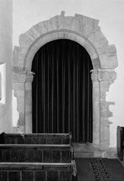
Object type: Two capitals and imposts [1]
Measurements:
a (north):
capital: H. 24 cm (9.5 in); W. 39 cm (15.4 in); D. 16.5 cm (6.5 in)
impost: (west side, south face) H. 28 cm (11 in)
W. 21 cm (8.3 in); (west face) H. 28 cm (11 in)
W. 53 cm (20.9 in); (east side, south face)
H. 26 cm (10.2 in); W. 21.5 cm (8.5 in); (east face) H. 26 cm (10.2 in); W. 47 cm (18.5 in)
b (south):
capital: H. 23 cm (9 in); W. 47 cm (18.5 in); D. 15 cm (5.9 in)
impost: (west side, north face) H. 28.5 cm (11.2 in); W. 20 cm (7.9 in); (west face) H. 28.5 cm (11.2 in) W. 22 cm (8.7 in); (east side, north face) H. 25 cm (9.8 in) W. 23 (9 in); (east face) H. 25 cm (9.8 in) W. 39.5 cm (15.6 in)
Stone type: (capitals): Pale grey (with a greenish tinge), shell-fragment limestone; Quarr stone, Bembridge Formation, Palaeogene, Tertiary; Isle of Wight (imposts): Pale yellow, soft, fine-grained limestone; Caen stone, Calcaire de Caen Formation, Bathonian, Middle Jurassic; Caen, Normandy
Plate numbers in printed volume: Ills. 183-191
Corpus volume reference: Vol 4 p. 179-181
(There may be more views or larger images available for this item. Click on the thumbnail image to view.)
The tower arch is of square section with soffit shafts carried round the head of the arch as a soffit roll. At each side the soffit shaft and roll are separated by a narrow abacus supported by a capital. The arch head and jambs are in turn separated by narrow recessed abaci below which are imposts flanking the capital and of similar height. These stand slightly proud of the jambs and are separated from them by narrow roll mouldings. At each side the abaci and imposts are returned along the east and west walls.
On the north side, a, the capital is decorated with three superimposed zones of narrow upright leaves with clubbed, out-turned ends. On each of the flanking strips is a large, inward-facing, tightly-scrolled volute composed of a half-round, tapering moulding encircling a domed berry bunch. The individual berries are in relief. The squared bases of the volutes touch the capital close to its lower edge. The inner edges of the volutes touch the capital, and the outer edges the return angles of the impost. The east face of the impost is decorated with a pair of similar outward-facing volutes with their squared bases touching its lower edge. The triangular area between the volutes is left in relief and longitudinally grooved. From the tip of the volute to the right a square-ended, expanding, relief moulding curves up to flank the volute. The west face of the impost is similarly decorated except that secondary, expanding, half-round mouldings develop from the tip of each volute.
On the south side, b, the capital and imposts are similar to those on the north side, except that the heavily damaged eastern volute flanking the capital faces outwards, and has a secondary, half-round, expanding moulding curving downwards and outwards developing from the tip. On the west face of the impost there is only a single volute.
The tower arch, with its use of a soffit roll and shafts, is of Romanesque form, and eleventh-century date; it is clearly of the same date as the upper stages of the west tower which employs applied half-round shafts and one similar capital. The lower stage of the tower represents the west end of the nave of a pre-Conquest church (Aldsworth and Harris 1988, fig. 8). Soffit shafts, such as those employed here, occur first on the continent from the second quarter of the eleventh century, as at Speyer in the Rhineland, in work of c. 1030–61 (Gem 1973, ii, 494; Conant 1974, ill. 90), or Le Mont St Michel in Normandy, under construction between 1034 and 1064 (loc. cit.). Soffit rolls, used in conjunction with shafts, are similarly a late feature, occurring first in the crypts of Auxerre and Nevers cathedrals in Burgundy, of c. 1030 and 1029 respectively (Bony 1967, 75; Conant 1974, 162, ill. 115). It is difficult to conceive of these features being introduced into England before the middle of the eleventh century, and indeed it is arguable that the tower arch at Sompting is as late as the 1080s or 1090s (Gem 1983, 128).
Further slight evidence for dating derives from the layout and form of the decoration. The use of capitals flanked by decorated imposts is unusual and is paralleled in England only at Langford, Oxfordshire, on the belfry windows (no. 4; Ills. 297–312), and on the continent at Bernay where similar imposts and capitals occur in the south transept in work dated to 1017–55 (Gem 1973, ii, 495, 522; idem 1983, 126). The use of debased composite or Corinthian forms, as here, where the volutes have been separated from the zone of upright leaves is difficult to parallel, but the suppression of one or other of these decorative zones to leave either upright leaf capitals or voluted capitals does occur, particularly in Lincolnshire. At Bracebridge and Glentworth there are volute capitals with the zone of upright leaves suppressed (Brown 1925, fig. 192, VII, XVI), and at Great Hale upright leaf capitals with volutes suppressed (ibid., fig. 192, XII, XIV). All of these capitals adorn belfries of the Lincolnshire type, for which a firm post-Conquest date can be argued (D. A. Stocker, pers. comm.).
Even if the tower arch as it stands is of later eleventh-century date, not all the elements of it need be contemporary. As has been pointed out (Aldsworth and Harris 1988, 121–2, fig. 14), the flanking imposts have every appearance of having been reshaped and reused in their present positions, presumably from the earlier building.
