Select a site alphabetically from the choices shown in the box below. Alternatively, browse sculptural examples using the Forward/Back buttons.
Chapters for this volume, along with copies of original in-text images, are available here.


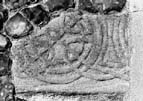
Object type: Fragment of panel
Measurements: H. 22 cm (8.7 in); W. 32 cm (12.6 in); D. Built in
Stone type: Pale greyish-yellow, oolitic limestone, with cross-bedding shown by shelly streaks; possibly Taynton stone, Taynton Stone Formation, Great Oolite Group, Middle Jurassic
Plate numbers in printed volume: Fig. 37; Ill. 454
Corpus volume reference: Vol 4 p. 263-264
(There may be more views or larger images available for this item. Click on the thumbnail image to view.)
The lower, original, edge is horizontal with a plain raised border; the left and right-hand edges are vertically broken and the upper edge horizontally broken. The upper left-hand corner is lost.
A (broad): From the upper edge, to the right of the vertical axis of the panel, develops a concave-sided, rounded-ended cross-arm, type E6, stopping short of the half-round border moulding along the lower edge. The edges of the arm are paralleled by an incised line. Abutting the arm, to the left, is an incomplete ring-knot based on three concentric circles with interlacing diagonals. Two of the strands are carried between the lower border and the end of the cross-arm, where they cross, and off to the right. To the right a single strand abuts the arm; the rest of the interlace is lost.
The fragment is probably to be reconstructed as a square, decorated with a free-armed cross with a circular interlace in each of the re-entrant angles. As noted above (Chap. IV), it may be part of a closure screen, or alternatively, part of a box altar or shrine, both features which employ decorated slabs.
The evidence for the dating of this panel is ambiguous. The use of a free-armed cross might suggest a date before the tenth century, by which time ring-heads and their derivatives predominated. In contrast, the use of closed-circuit loops in the interlace points to a late date, as this feature does not normally occur before the tenth century (Collingwood 1927, 65, 68). A late date may be confirmed by the uneven laying-out of the decoration, a feature more characteristic of later Anglo-Saxon interlaces than of earlier material. On this basis, perhaps a late date is to be preferred.
