Select a site alphabetically from the choices shown in the box below. Alternatively, browse sculptural examples using the Forward/Back buttons.
Chapters for this volume, along with copies of original in-text images, are available here.


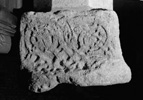
Object type: Cross-base [1]
Measurements: H. 46 cm (18 in); W. 60 cm (23.6 in); D. 59 cm (23.2 in) Diameter of bowl 68 cm (26.8 in)
Stone type: Pale grey to pale brownish-grey, finely granular, cavernous-weathered limestone; Bembridge limestone, Bembridge Formation, Palaeogene, Tertiary; Isle of Wight
Plate numbers in printed volume: Fig. 38; Ills. 465-9
Corpus volume reference: Vol 4 p. 265-266
(There may be more views or larger images available for this item. Click on the thumbnail image to view.)
It takes the form of an inverted truncated pyramid with the edges rounded to a greater or lesser degree by weathering. Around the upper edge is a heavily weathered, boldly-projecting moulding of square section which is partially broken away on faces A and D. The bowl of the font is circular with inward-curving sides and a flattened base. An irregular hole has been pierced through face B about a quarter of the way up from the mid-point of its lower edge. The decoration on all the faces has been badly damaged by weathering (Fig. 38).
A: Decorated with a pair of broad, inward-scrolling mouldings linked together along the lower edge, and touching before curling under. Each terminates in a U-shaped feature, the outer end of which is slightly concave and the edges extended to accommodate a disc. The outer edge is simply out-turned, but the inner edge of each motif develops into a narrow straight moulding running up towards the vertical axis of the face. The two mouldings converge and touch on the edge of the upper border.
B: Decorated with broad interlacing bands, the design rendered incoherent by weathering.
C: Two inward scrolling mouldings, one to each side of the face, interlace with various oblique strands; again the design is largely destroyed.
D: There is a number of broad interlacing strands, some of which appear to be longitudinally ribbed.
The hole in face B may be of relatively modern date, since it is difficult to see how the piece could have been successfully used as a pump trough with a large hole in one side. As noted in Chap. IV, whatever its original function this piece is very unlikely to have begun life as a font. Every single surviving font from southern England is of circular section, as are those from other regions. If not a font, then it seems most likely to have been a cross-base of truncated pyramidal form, a type known at Raistrick and Walton, Yorkshire (Collingwood 1915, 231–3, 250–4).
The weathered nature of the decoration makes dating extremely hazardous, but the combination of spiral-based ornament and plant ornament is suggestive of a late eighth or early ninth-century date, a period when spiral ornament was dropping out of use and plant ornament making its first consistent appearance in Anglo-Saxon art (Budny and Graham-Campbell 1981, 11). This dating is supported if the decoration on face C can be interpreted as a double-spiral animal. This form is both distinctive and rare, occurring only on two eighth-century manuscripts, fol. 16r of the Leningrad Gospels (Alexander 1978, no. 39, ill. 190) and fol. 102r of Hereford cathedral Library MS P. I. 2 (ibid., no. 38, ill. 199).
