Select a site alphabetically from the choices shown in the box below. Alternatively, browse sculptural examples using the Forward/Back buttons.
Chapters for this volume, along with copies of original in-text images, are available here.


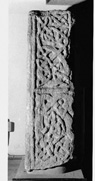
Object type: Part of cross-shaft [1]
Measurements: H. 94 cm (37 in); W. 36 cm (14.2 in); D. 28 cm (11 in)
Stone type: Pale brownish-grey, medium-grained, oolitic limestone, with some worn shell fragments; Middle Jurassic, of uncertain provenance
Plate numbers in printed volume: Fig. 9; Ills. 470-472
Corpus volume reference: Vol 4 p. 267-268
(There may be more views or larger images available for this item. Click on the thumbnail image to view.)
Part of a tapering shaft of square section, dressed roughly flat above and below.
A (broad): Extensively damaged, the lower left-hand corner of the face is lost, and the face is dressed flat to the left of a line between the upper left and lower right-hand corners. Above and to the right is a plain, low-relief, border with double mouldings. The face is divided into two fields, of which the upper is slightly the larger, by a narrow horizontal moulding of square section.
The decoration of the lower field has been entirely defaced, but in the upper field is a thick, ribbon-like animal body, forming a loop touching the upper and lateral borders, before the tapering ends of the body cross and develop into disorganised interlace. The principal feature of this interlace is a pair of pointed loops, one running into each of the upper corners, through which the body passes. The interlace strands are median-incised (Fig. 9b).
B (narrow): Face B has been trimmed back to the right, but to the left has a border with broad, low-relief, plain, double mouldings. The face is divided into two fields of which the upper is the larger, by a plain horizontal moulding of indeterminate section.
In the upper field a thick ribbon-like animal body forms a loop almost touching the lower border. The body tapers towards the upper ends, which cross and develop into disorganised interlace with median-incised strands. A prominent feature of this is a pair of pointed interlace loops, one running into each of the lower corners, through which the animal's body passes.
In the lower field is a pair of confronted interlocking ribbon-like animals whose bodies taper towards the head. The head of the first is placed in the upper left-hand corner of the field and faces outwards and downwards, its body curves across to touch the right-hand border before curving back to the left. The second animal is similarly posed, but faces in the opposite direction. It has a square snout, a slightly upward-curving upper jaw, a prominent bulging forehead, and a small pointed ear. Under its chin is a pellet. The head of the first animal is similar, but has a pecked eye, and no pellet. The bodies of both animals are contoured with an incised line and hatched. They are involved in disorganised, median-incised interlace issuing from the animals' mouths (Fig. 9a, c).
C (broad) and D (narrow): Destroyed.
