Select a site alphabetically from the choices shown in the box below. Alternatively, browse sculptural examples using the Forward/Back buttons.
Chapters for this volume, along with copies of original in-text images, are available here.


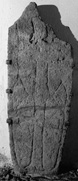
Object type: Grave-cover
Measurements: L. 157 cm (61.8 in); W. 59 cm (23.2 in); D. 12 cm (4.7 in)
Stone type: Yellowish-grey to pale yellow, fine- to medium-grained (0.2 to 0.3-mm quartz grains), finely glauconitic sandstone; Hythe Beds, Lower Greensand Group, Lower Cretaceous; Petersfield to Pulborough area
Plate numbers in printed volume: Ill. 249
Corpus volume reference: Vol 4 p. 197-198
(There may be more views or larger images available for this item. Click on the thumbnail image to view.)
It is incomplete, a rough break rising steeply from right to left before falling slightly again. The cover is parallel sided before tapering slightly towards the foot.
A (top): A narrow border is defined by an incised line paralleling the edge of the stone, except where it curves round the lower corners. At the bottom is a Latin cross outlined by incised lines. Its foot rests on the lower border, but the arms stop short of the borders to each side. The limbs are parallel sided, but the foot expands abruptly just before it touches the borders; the head of the cross expands in a similar fashion. At the head end a similar cross faces in the opposite direction, and the heads of the two crosses touch.
Appendix A item (stones dating from Saxo-Norman overlap period or of uncertain date).
Its find-spot suggests that this stone had either been used in the foundations of the twelfth-century church, or covered by them, although the evidence is hardly conclusive. Additional dating evidence derives from the comparison which can be drawn between this piece and a grave-cover from Stedham (no. 3; Ill. 238) which is also decorated with two crosses, one at either end, and for which an eleventh-century date is argued above. Other eleventh-century Sussex covers at Stedham and Chithurst (e.g. no. 2; Ill. 221) employ a median ridge which is crossed near each end, a type which must ultimately derive from the double cross form.
