Select a site alphabetically from the choices shown in the box below. Alternatively, browse sculptural examples using the Forward/Back buttons.
Chapters for this volume, along with copies of original in-text images, are available here.


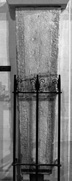
Object type: Grave-cover, in two joining pieces
Measurements: H. 202.5 cm (79.7 in); W. 56 > 37 cm (22 > 14.5 in); D. 11.5 cm (4.5 in)
Stone type: Medium light grey, shell-fragment limestone; (Quarr stone)
Plate numbers in printed volume: Ills. 695-709
Corpus volume reference: Vol 4 p. 335-337
(There may be more views or larger images available for this item. Click on the thumbnail image to view.)
The tapering grave-cover is broken into two approximately equal parts.
A (top): Inscription The inscription (Ill. 695; Okasha 1971, 114–15) runs between framing lines that follow the edge of the upper surface of the stone. The text starts at the left-hand corner of the head of the stone and continues around the whole perimeter. The feet of the letters face inwards. The interval between the framing lines varies between 5.5 and 7 cm (2.2 and 2.75 in) and the letters are between about 3.4 and 4.8 cm high. The letters were quite deeply cut into the coarse-grained stone. Though there is considerable damage to the surface, some of the grooves and parts of the framing lines preserve traces of reddish colouring. The inscription (Ills. 698–709) is in capitals and can be transcribed as follows:
(top): +VIII:[K]L:OCTB:
(right): FVI[T]:POS[IT]VS:ÆG[EL]ƿ[AR]DVS:FILIVS:
KY[P]PINGVS:INISTO[:]L[OC]O
(bottom): BEATV
(left): S:SIT[:]OMO:QVIO[R]AT:PROANI[MA]:EIVS:
+TOKI:M[E]:S[CRIP]SI[T]:
The language is clearly Latin. Although two letters are damaged on both the left and right sides by the crack that runs across the stone, enough remains of the two most damaged letters to confirm the readings demanded by the context (the R of ÆG[EL] ƿ [AR]DVS and the second A of ANI[MA]). Otherwise the reading is straightforward:
+ VIII : K(A)L(ENDAS) : OCT(O)B(RES) : FVIT :
POSITVS : ÆGELƿA[R]DVS : FILIVS :
KYPPINGVS : IN ISTO [:] LOCO BEATVS : SIT
OMO : QVI ORAT : PRO ANIM[A] : EIVS : +
TOKI ME : SCRIPSIT :
(Translation: '+ On the eighth day before the Kalends of October [24 September] Ægelward son of Kypping was buried in this grave. Blessed be the man who prays for his soul. + Toki wrote me.').
The inscription is in boldly cut capitals. The strokes are of even breadth and are consistently seriffed. The letters approximate to the standard Roman forms with the following exceptions. There are three variants of A, each with a bar across the top (Ills. 700, 704, 707). In two variants (one with a straight cross-bar and the other with an angular one) the top bar cuts the diagonals before they can meet to form an angle. In the other (with an angular cross-bar) the top bar rests on the angle formed by the diagonals. C is angular on two occasions and round on one (Ills. 698, 703). A square form of G is used (Ills. 700, 702). K consists of a vertical linked to a shorter C-shaped form by a short horizontal (Ills. 698, 701, 708). M has vertical outer strokes and a shallow central 'V' (Ill. 705). Q is the uncial form (Ill. 705). Y consists of a short diagonal on the left which meets the full-length right diagonal half-way down and has a dot in the upper angle (Ill. 702). The Old English masculine personal name ÆGELƿARDVS is spelled with the Æ diphthong and the Old English graph wynn (Ill. 700–1). In the word FILIVS the second I is shortened and fitted above the leg of the L (Ill. 701).
Words are generally separated by a mid-line point. The principal exceptions are short preceding words such as prepositions which are not divided from the following word. A group of three dots similar to that used at the end of the inscription from Whitchurch no. 1, Hampshire (Ill. 486) marks the end of the top line and fills the awkward corner space. Introductory crosses mark off the two principal sections: the epitaph and the 'signature'.
The Latin shows one or two non-Classical features: fuit positus for perfect passive; Kyppingus instead of genitive Kyppingi; omo for homo.
Appendix A item (stones dating from Saxo-Norman overlap period or of uncertain date).
Inscription The form of the Y was probably derived from Carolingian minuscule and does not seem to appear on surviving Anglo-Saxon inscriptions of earlier date than the Brussels cross of the early eleventh century; the form is also used on the Bayeux Tapestry (Okasha 1971, pl. 17c; Stenton 1957, pls. 19, 65; Wilson 1985, pls. 17, 64).
The principal text is an epitaph which records the date of burial, rather than that of death, and the name and patronymic of the deceased, and continues with a request for prayers for his soul. The phrase 'POSITUS . IN ISTO LOCO' may reflect the biblical 'venite et videte locum ubi positus erat dominus' (Matthew 28, 6). The elements positus and in hoc loco seem to be characteristic of the Early Christian period and appear separately quite commonly in Early Christian epitaphs and in one or two cases together (Diehl 1925–67, ii, 223, 231, nos. 3503, 3527A, iii, 546–7, 567). Requests for prayers for the soul of the deceased are common in medieval memorial inscriptions and are found from the Early Christian period onwards (Marucchi 1912, 137–89). 'BEATUS SIT (H)OMO QUI' echoes the biblical 'beatus vir qui' (Psalms 1, 1, etc.) and 'beatus homo qui' (Job 5, 17; Psalms 88, 13; 99, 12; Proverbs 3, 13; 28, 14), although the subjunctive sit is not biblical. The second text ('TOKI ME SCRIPSIT') is a 'signature' of the type common in the Anglo-Saxon period in which the object is made to speak. The verb scripsit may refer to the drafting of the text and/or the design of the lettering rather than to the cutting of the letters (Higgitt 1990, 151–2).
The names Ægelwardus and Kyppingus represent the Old English masculine personal names Æthelweard and Cypping; Toki is a masculine personal name of Old Norse origin (Feilitzen 1937, 102–6, 188–9, 221–2, 385–6; Okasha 1971, 115, 152–4). Campbell suggests that the spelling Ægel- for Æðel- in Old English charters and on coins, which is frequent from the late tenth century onwards, was an affectation due to a sound-change in French (Campbell 1959, 195, n. 5). Kypping may have been related to the Cheping who held Stratfield in the time of Edward the Confessor (Okasha 1971, 115).
The lettering, the presence of a Scandinavian name, and the form of the name Ægelwardus, would fit a date in the eleventh century, not necessarily before the Conquest.
