Select a site alphabetically from the choices shown in the box below. Alternatively, browse sculptural examples using the Forward/Back buttons.
Chapters for this volume, along with copies of original in-text images, are available here.


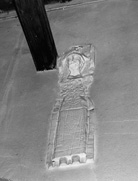
Object type: Crucifixion [1]
Measurements: H. c. 135 cm (53 in); (W. 36 cm (14 in); D. Built in
Stone type: Inaccessible. A soft, white (possibly whitewashed) fine-grained stone, probably Chalk to judge from the way in which the lower part of the figure has been carved; Middle Chalk or Upper Chalk, Upper Cretaceous; from the Walkern vicinity
Plate numbers in printed volume: Ill. 397
Corpus volume reference: Vol 4 p. 240-241
(There may be more views or larger images available for this item. Click on the thumbnail image to view.)
The crucifixion is in situ over what was originally the south door of the aisleless nave of the church. In the twelfth century an arcade was cut through this wall and an aisle created. This left one impost of the south door in situ, but removed the other (Taylor and Taylor 1965–78, ii, 629–30, fig. 319). At the same time, or subsequently, the lateral arms of the crucifixion and the area of the figure's chest were cut away to accommodate a wooden beam.
The figure is a robed crucifixion of the same general type as Langford 2, Oxfordshire (Ills. 294–5), for which an eleventh-century date has been argued. For further discussion of the dating of the crucifixion groups from south-east England, see Chap. VII.
