Select a site alphabetically from the choices shown in the box below. Alternatively, browse sculptural examples using the Forward/Back buttons.
Chapters for this volume, along with copies of original in-text images, are available here.


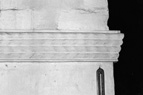
Object type: Impost
Measurements: H. 19 cm (7.5 in); (W. 77 cm (30.3 in); D. 54 cm (21.3 in)
Stone type: Unidentified (thickly covered with greyish-white limewash or emulsion paint)
Plate numbers in printed volume: Ill. 398-399
Corpus volume reference: Vol 4 p. 241
(There may be more views or larger images available for this item. Click on the thumbnail image to view.)
This piece originally formed the eastern impost of the south door of an aisleless nave, above which Walkern no. 1 was situated. The western impost was removed when, in the twelfth century, an aisle was built and an arcade cut through the south wall of the church.
Clearly the creation of the arcade implies that the impost is of earlier date, and an eleventh-century dating can be suggested if it is accepted that the door and the crucifixion figure belonged to the same architectural scheme (see Walkern 1 and Chap. VII). Confirmation of this dating derives from the form of the cabled mouldings on the impost. These are modelled with a V-shaped incision on the median line of each strand. This is precisely the form encountered elsewhere in works probably of the eleventh century, such as Little Munden in Hertfordshire (Ills. 318–19), and Dartford (Ill. 61) and Orpington (Ills. 105–7) in Kent.
