Volume 4: South-East England
Select a site alphabetically from the choices shown in the box below. Alternatively, browse sculptural examples using the Forward/Back buttons.
Chapters for this volume, along with copies of original in-text images, are available here.
Current Display: West Wittering 01, Sussex


Overview
Object type: Architectural feature
Measurements: H. 22 cm (8.7 in); W. 24 cm (9.5 in); D. 10 cm (3.9 in)
Stone type: Greyish-yellow, medium- to coarse-grained, oolitic limestone, with a millet-seed texture and without obvious shell fragments; of uncertain provenance, perhaps Great Oolite Group, Middle Jurassic
Plate numbers in printed volume: Ills. 217-18
Corpus volume reference: Vol 4 p. 186-187
(There may be more views or larger images available for this item. Click on the thumbnail image to view.)
Present Location
In a case fixed to the east face of the westernmost pillar of the arcade between the chancel and the south chapel
Evidence for Discovery
Found 'embedded in the masonry' of a wall (perhaps east wall or south aisle wall) during restoration in 1875 ((—) 1875b); kept loose in the south chapel until placed in present position in 1958
Church Dedication
Sts Peter and Paul
Present Condition
Broken and chipped; otherwise well preserved
Description
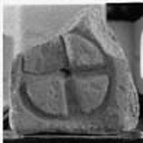
It is sub-rectangular and dressed flat on faces D and F. Only two faces are carved; both use incised lines of V-shaped section.
A (broad): The damaged right-hand edge slopes inwards, and the upper edge is broken and rises to the right. The break has partially removed the irregular circle enclosing a Greek cross. Its centre is roughly hollowed.
C (broad): There is a saltire cross, its centre drilled, within a circle.
Discussion
The east wall of the church is early thirteenth century and the south aisle wall of c. 1175–1200 (Nairn and Pevsner 1965, 377; Done 1965, 8). The piece must be of earlier date if it was reused as building material in one of these walls. As Radford has pointed out (Done 1965, fig. on 7), the piece was first used as a gable cross, actually forming the apex stone of the gable, and probably with an incised Greek cross. Subsequently the stone must have been turned over, rotated through about 135 degrees, and used again at the apex of the gable, this time probably with an incised saltire cross. Radford has suggested that the primary use was as early as a charter mentioning West Wittering in c. 740, and the secondary use was late Anglo-Saxon (Done 1965, 5); however, there is no clear dating evidence. Allowing a reasonable period of primary and secondary use before the stone was used as building material, then the period of primary use at least was probably before the Conquest, and the period of secondary use may have been. The form of the cross on both sides is related to circle-headed crosses, such as that from near-by Pagham (Ills. 99–100). This may also point to a pre-Conquest date, and one at the earliest in the tenth century, when this type of head was introduced.
Date
Tenth to eleventh century
References
( --- ) 1875b, 276; Salzman 1953, 220; Done 1958 - 62, 228 - 9; Done 1965, 4 - 8, fig. on 7, pls. following 20; Tweddle 1986b, i, 85 - 6, ii, 505, iii, pl. 112
D.T.
Endnotes