Select a site alphabetically from the choices shown in the box below. Alternatively, browse sculptural examples using the Forward/Back buttons.
Chapters for this volume, along with copies of original in-text images, are available here.


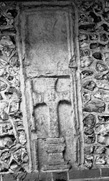
Object type: Grave-cover
Measurements: H. 122 cm (48 in); W. 32 cm (12.6 in); D. Built in
Stone type: Yellowish-grey to pale orange, medium- to coarse-grained, slightly shelly, oolitic limestone, with some ovoid pellets up to 3 mm long; probably Combe Down Oolite, Great Oolite Formation of the Bath area, Great Oolite Group, Middle Jurassic
Plate numbers in printed volume: Ill. 473
Corpus volume reference: Vol 4 p. 269-270
(There may be more views or larger images available for this item. Click on the thumbnail image to view.)
The cover tapers towards the lower end.
A (top): The lower border does not survive; that to the left has a narrow, plain, low-relief moulding, and those above and to the right have plain, low-relief, double mouldings. A similar double moulding divides the face into two fields, the lower of which is the larger. The upper field is undecorated but heavily chiselled. The lower field is decorated with a Latin cross, the head and horizontal arms of which are expanding and concave sided, with curved re-entrant angles. Their square ends terminate on the border. Each arm is separated by a pair of narrow transverse cabled mouldings from the point of junction which is decorated with a rosette which has a central boss and seven expanding, rounded-ended petals. The lower limb of the cross is straight sided and slightly expanding, and stands on an elaborate base which in turn rests on the lower edge of the stone. The lower element of the base consists of a broad roll moulding with rounded ends which supports a similar narrow recessed moulding on which rests a short tapering stem. This supports a series of five mouldings, each with rounded ends, and projecting beyond the stem. The upper and lower mouldings are cabled, and the median moulding pelleted. A broad low-relief moulding with rounded ends separates this group of mouldings from the lower limb of the cross.
