Select a site alphabetically from the choices shown in the box below. Alternatively, browse sculptural examples using the Forward/Back buttons.
Chapters for this volume, along with copies of original in-text images, are available here.


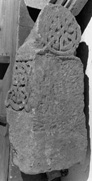
Object type: Part of cross-shaft
Measurements: H. 86 cm (34 in); W. 34 cm (13.4 in)
Stone type: Yellowish-grey, medium-grained, oolitic limestone, with shell fragments including a lunate Ostreid; Middle Jurassic, of uncertain provenance
Plate numbers in printed volume: Ill. 479-481
Corpus volume reference: Vol 4 p. 270-271
(There may be more views or larger images available for this item. Click on the thumbnail image to view.)
The stone was reshaped as a corbel in the thirteenth century. The shaft is of rectangular section and tapers towards the upper end which has been re-cut to form a conical corbel whose face is on the same plane as face A. The shoulders between the corbel and the shaft are irregularly stepped.
A (broad): On the face of the corbel is a heavily damaged encircled interlace of pattern C, the ends of the diagonals having been cut away by the shaping of the corbel. The rest of the face is undecorated.
B (narrow): Face B is decorated with a single rectangular panel, incomplete above and damaged to the right, which is decorated with interlace, a unit of complete pattern A.
C (broad): Irregularly cut back.
D (narrow): There is a single rectangular panel in the corresponding position to that on face B. This has a plain relief border above, but is damaged to the left, and is filled with an encircled pattern C interlace or ring-knot, with median-incised strands.
