Volume 4: South-East England
Select a site alphabetically from the choices shown in the box below. Alternatively, browse sculptural examples using the Forward/Back buttons.
Chapters for this volume, along with copies of original in-text images, are available here.
Current Display: Winchester (High Street) 01, Hampshire


Overview
Object type: Part of cross-shaft
Measurements: H. 19.5 cm (7.7 in); W. 16.5 cm (6.5 in); D. 10.5 cm (4.1 in)
Stone type: Light grey, medium-grained, oolitic limestone, with shell detritus, possible echinoid fragments, and planar bedding; Middle Jurassic; of uncertain provenance
Plate numbers in printed volume: Ills. 679-682
Corpus volume reference: Vol 4 p. 331
(There may be more views or larger images available for this item. Click on the thumbnail image to view.)
Present Location
Winchester City Museum stores
Evidence for Discovery
Discovered in 1963 when wall in basement of what was then National Provincial Bank demolished; twelfth-century capital also recovered
Church Dedication
High Street
Present Condition
Light grey, medium-grained, oolitic limestone, with shell detritus, possible echinoid fragments, and planar bedding; Middle Jurassic; of uncertain provenance
Description
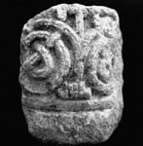
Part of a shaft of circular section, dressed flat below but broken above and to the rear, so that less than one-third of the circumference survives.
Along the lower edge is a broad, plain frame of convex section, above which is a second, narrower, plain relief frame. Above this the shaft is decorated with a bush scroll. The stem stands on a stepped base and is median-incised; only a single pair of scrolled branches survive, each is median-incised and leafless. The end of each scroll is turned up to form a diagonal which interlaces with the scroll before curving up to flank the main stem and run off the broken edge above.
Discussion
Probably part of a round shaft built in section, as the lower face appears to be original and dressed flat. As the round shaft was a ninth-century innovation (Cramp 1978, 9), this provides a terminus post quem for the piece. This dating is confirmed by the decoration. As noted in Chap. V, the occurrence of plant ornament points to a date in the late eighth century at the earliest, as before this date plant ornament was not established in the repertoire of Anglo-Saxon art on south-east England. Tree-scrolls, the form employed here, were widely used in the late eighth and ninth centuries, and persisted as late as the early tenth century, as on the shaft from East Stour, Dorset (Backhouse et al. 1984, no. 23, pl. 2).
Date
Ninth century
References
Tweddle 1983b, 22, pl. VIIa; Tweddle 1986b, i, 95, 150 - 1, ii, 514 - 15, iii, pl. 120a
D.T.
Endnotes