Select a site alphabetically from the choices shown in the box below. Alternatively, browse sculptural examples using the Forward/Back buttons.
Chapters for this volume, along with copies of original in-text images, are available here.


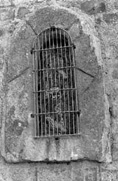
Object type: Grave-marker
Measurements: H. 66 cm (26 in) ; (W. 40 cm (15.8 in); D. Built in
Stone type: Yellowish-grey, oolitic limestone, with planar bedding of alternate medium-grained and coarser to pellety shelly layers, and lacking calcite veins; Barnack stone, Lincolnshire Limestone Formation, Inferior Oolite Group, Middle Jurassic
Plate numbers in printed volume: Fig. 35; Ill. 375
Corpus volume reference: Vol 4 p. 242-243
(There may be more views or larger images available for this item. Click on the thumbnail image to view.)
It is used as the exterior frame of a semicircular-headed window. Only one face is visible.
A (broad): The upper part is decorated with the remains of a circular, splayed-armed cross, the fields between the arms being recessed. Only the curved outer ends of the recessed fields flanking the lower arm survive. The outer ends of the lateral and the upper arms of the cross have been destroyed by the rounding of the head of the stone. The lower arm and the centre of the cross have been destroyed by the cutting of the opening.
The reconstruction of this fragment (Fig. 35) is slightly problematical, as it could either have been a square-headed grave-marker which has been completely reshaped, or one with a semicircular head which has merely been trimmed and pierced. Square-headed types are known from Peterborough with the same type of cross as here, and from Cambridge castle with a square-armed cross (Fox 1920–1, pl. VII). There is no adequate parallel for the putative semicircular headed type, although there is something similar, but with an almost circular head, from Cambridge castle (loc. cit.).
Dating is equally problematic. The Royal Commission places the window of which it now forms the frame in the late eleventh century, and this certainly suggests a pre-Conquest date for the piece (R.C.H.M. 1916, 252). This date is supported by the parallels among other material from East Anglia. As Fox has pointed out, a pre-Conquest date must be preferred for the vast majority of this material (Fox 1920–1, 31–6).
