Select a site alphabetically from the choices shown in the box below. Alternatively, browse sculptural examples using the Forward/Back buttons.
Chapters for this volume, along with copies of original in-text images, are available here.


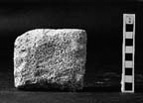
Object type: Plaque
Measurements: H. 8.5 cm (3.3 in); W. 9.7 cm (3.8 in); D. 2.7 > 2.2 cm (1 > 0.8 in)
Stone type: Whitish-grey, medium- to coarse-grained, shelly, oolitic limestone; Combe Down Oolite, Great Oolite Formation of the Bath area, Great Oolite Group, Middle Jurassic
Plate numbers in printed volume: Ills. 676-678
Corpus volume reference: Vol 4 p. 331-333
(There may be more views or larger images available for this item. Click on the thumbnail image to view.)
A flat plaque, only one face of which is carved. The four edges of the stone are carefully dressed, the tooling still visible. None of the tooling appears to be secondary. The piece is therefore complete except for a small loss affecting the top bar of the square capital C on face A. The left-hand edge (face D) is flat. The back (face C) is tooled flat, but not smooth; the top edge (face E) is bevelled smoothly into the back; the bottom and right-hand edges are bevelled more roughly.
A: The only carved face is dressed smooth, bearing a deeply incised inscription (see below).
Inscription The letters of the inscription (Okasha 1983, 102–3) are incised with broad strokes of unusual section (Ill. 678). The letter-strokes consist of roughly flat-bottomed troughs and are wider at the bottom of the trough than at the surface of the stone. The sides are therefore somewhat undercut. This would preclude the use of the letters as moulds because cast letters could not be extracted in one piece without breaking the overhanging edges of the letter strokes. The cross-section of the troughs is, however, very suitable for holding inlaid lettering, though there is no visible evidence of inlay.
The letters vary between about 4.8 cm (1.9 in) (H and C) and about 5 cm (2 in). The inscription, which is in capitals, reads:
--HIC--
This is presumably the Latin word hic ('here'). This would make little sense on its own and so further text must have been lost (or at least intended) at one or both ends.
The lettering consists of three capitals. H and I conform to the standard Roman forms. C is square. There are no true serifs. Instead strokes expand gradually towards the ends in a manner which Okasha has called 'stem thickening' (Okasha 1968, 332; Higgitt 1990, 35–6, which fails to refer to this example of incised 'stem thickening').
It is perhaps possible that this was a trial piece, but its size would have made it difficult to hold while being worked. It may alternatively have been cut down for reuse, but it is not obvious why this should have been done. The tooling, the surface appearance, and the slight degree of weathering, all suggest that the surfaces are contemporary and that the stone is complete in itself. If so, it must have formed part of an inscription (see below), presumably from a burial, with the remaining words cut on another stone or stones. A small cemetery of seventh to early-eighth century date lay below the later church of St Mary, 12 m to the south of the find-spot. A more likely source, however, may be the church of St Pancras, 20 m to the west, where two burials of tenth- or early eleventh-century date were found. The digging of tanning and other pits in the tenth and eleventh centuries could easily explain the removal of the stone from its original position.
It seems possible that the cuts in the stone were intended to hold metal letters, perhaps lead, which had been poured into the deep shapes. Because the edges of the letters are undercut the casts could not have been easily removed and the stone is not therefore a mould (see above). Grave-stones with legends in lead letters between 40 and 60 mm high let into the surface of the stone are, however, known from Saint-Martin at Tours (Deschamps 1929, pl. II, fig. 2; Vieillard-Troiekouroff 1962, 112–13, figs. 33–5; Gray 1986, fig. 69: see Mitchell 1992, 212, n. 51) and are apparently dated to the second quarter of the ninth century.
Inscription The word HIC might come from a memorial inscription with a formula of the hic requiescit type or something similar. This, however, is only one possibility.
An interesting parallel for 'stem thickening' in incised lettering can be seen in a fragment of a probably pre-Conquest inscription found in 1904 in Shaftesbury (Okasha 1983, 98). This has subsequently been lost and can now only be judged from a rubbing. The lettering clearly was embellished with 'stem thickening'. The best explanation for such broad strokes and 'stem thickening' in an incised inscription would be that the letters were designed for an inlay. This may also have been the case with the Winchester stone, any possible material used for inlay having perhaps been subsequently destroyed; or perhaps the stone was never used for its intended purpose. If it is true that none of the tooling is secondary (see above), it is possible that the inscription was made up of several blocks with inlaid lettering fitting together, possibly as part of a floor.
If, as has been suggested, the Shaftesbury fragment once formed part of the inscription that is mentioned by William of Malmesbury (William 1870, 186), it must have dated from no earlier than the time of Alfred (and more probably later) and was old by William's time (Radford 1970, 87). The archaeological evidence suggests that the Winchester fragment was made some time before the middle of the eleventh century (see below).
It is possible that the Winchester and Shaftesbury fragments represent an otherwise unrecorded tradition of inlaid lettering in southern England in the later pre-Conquest period. The idea might have been Carolingian in origin: the epitaph of Adelberga in Tours (c. 840) has lead-filled letters (Gray 1986, fig. 69). Lettering cut with similar broad, flat-bottomed strokes, perhaps also intended for some kind of inlay, can be seen in the memorial inscription to Bishop Bernward of Hildesheim (993–1022) which was formerly on the exterior of the western choir of his church of St Michael (Berges and Rieckenberg 1983, 101–3, 179, taf. 18; Brandt and Eggebrecht 1993, i, pl. on 24).
