Select a site alphabetically from the choices shown in the box below. Alternatively, browse sculptural examples using the Forward/Back buttons.
Chapters for this volume, along with copies of original in-text images, are available here.


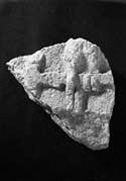
Object type: Fragment of grave-marker [1]
Measurements: H. 30 > 5 cm (11.8 > 2 in); W. 30 > 10 cm (11.8 > 3.9 in); D. 13 > 10.8 cm (5.1 > 4.3 in)
Stone type: Grey, porous, shell-fragment limestone; Quarr stone, Bembridge Formation, Palaeogene, Tertiary; Isle of Wight
Plate numbers in printed volume: Ills. 657-658
Corpus volume reference: Vol 4 p. 323-324
(There may be more views or larger images available for this item. Click on the thumbnail image to view.)
Only one carved face survives.
A (broad): A straight ridge running horizontally across the face is likely to be the remains of the lower frame. To the left, just above the upper arm of the cross, a curved edge may reflect the inner edge of the left-hand frame. A right hand, palm outwards, holding a horizontal cross, comes vertically down from above. The hand is in a blessing position, the second and third fingers outstretched, with the cross-shaft held between thumb and forefinger, and by the two folded fingers. The thumb would not have been visible if the hand had been shown from the other side. The cross has a long shaft, 14.5 cm surviving, and 2.8 cm wide. The cross-head has four arms expanding from a round central area, diameter 5.6 cm, in which the central setting-out point still survives. Only the lower arm of the cross survives to its whole length, projecting 5 cm from the central area and 7.3 cm from the centre-point. The arm splays from 2.8 to 4.8 cm, and is crossed by two incised lines set 0.9 cm apart and equidistant from the outer end and from the central circle.
The carving is of better quality than Winchester (Old Minster) no. 2 (Ill. 498). If the stone is correctly aligned in Ill. 657, the Hand of God appears to come down from above, like Winchester (St Pancras) 1 (Ill. 675), and not from the side, as on (Old Minster) 2. At first glance the present piece is very like (St Pancras) 1, which is much less well preserved, but the two are not identical, the latter being smaller and differently proportioned.
There is no sign of a cloud on (New Minster) 1, but this could have been broken away. The Hand of God blessing from the top right, without a cloud, can be seen in the Old English Hexateuch, a manuscript of the second quarter of the eleventh century, fol. 26v. But the more usual way for the Hand of God to be shown is coming from a sleeve (much more rarely from a sleeve and a cloud, or from a cloud alone), as on roods like Breamore (no. 1; Ill. 427), Headbourne Worthy (no. 1; Ill. 448), and Romsey (no. 1; Ill. 452), all in Hampshire. At Romsey the hand is well enough preserved to determine how the fingers are shown: they are stretched and the palm is outwards, the hand projecting from a sleeve which comes out of a stormy cloud. It is much more common in ivory, stone, and illumination to have the Hand of God coming out of a wide sleeve, and it is usual for the Hand not to be in a blessing position, but with an open palm, and outstretched fingers (like a helping hand rather than a blessing hand). This can be seen, for example, in the late tenth-century Winchester manuscript, the Benedictional of Archbishop Robert (Rouen, Bib. Mun. MS Y. 7, fol. 29v (Temple 1976, no. 24, frontispiece)). The Hand of God can also be seen on coins of Aethelred II, who may have intended the Hand of God to be the distinctive emblem on the reverse of his coinage. Initially an open hand coming down from above out of a sleeve, palm forwards and fingers outstretched (the so-called 'First Hand' and 'Second Hand' types of c. 979–85 and c. 985–91), the Third Hand type of c. 991 (the so-called 'Benedictional Hand') shows the hand as previously but now with the fingers in the blessing position and with a small equal-armed cross on the sleeve above (Blackburn 1991, 158–60, pls. 8.4–6).
In manuscripts, hands in a blessing position more often come from the top right, for example, in the York Gospels (York Minster, Chapter Library MS Add. 1, fols. 22v, 60v, 85v (Temple 1976, no. 61, ills. 181, 183–4)) and in Oxford, Bodleian Library MS Bodley 155, fol. 93v (ibid., no. 59, ill. 178), but there are good examples of a blessing hand, with the thumb not folded over, coming directly from above, straight out of a cloud, in the Judith of Flanders Gospels, fol. 1v (ibid., no. 93, ill. 289), and the Hereford Troper, fol. 31 (ibid., no. 97, ill. 295). None of these hands holds a cross, however. The Hand of God also appears in several Norman tympana, but again does not hold a cross. For further discussion, see Winchester (Old Minster), no. 2.
