Select a site alphabetically from the choices shown in the box below. Alternatively, browse sculptural examples using the Forward/Back buttons.
Chapters for this volume, along with copies of original in-text images, are available here.


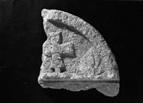
Object type: Part of round-headed grave-marker(?)
Measurements: H. 35.3 > 12.5 cm (13.9 > 4.9 in); W. 36 > 15 cm (14.2 > 5.9 in); D. 9.6 > 5 cm (3.8 > 2 in)
Stone type: Grey, porous, shell-fragment limestone, including some recognizable gastropod moulds; Quarr stone, Bembridge Formation, Palaeogene, Tertiary; Isle of Wight
Plate numbers in printed volume: Ills. 661-663
Corpus volume reference: Vol 4 p. 324-325
(There may be more views or larger images available for this item. Click on the thumbnail image to view.)
This is the right-hand half of the upper, semicircular part of what was probably a grave-marker. Only one face is carved.
A (broad): At the bottom there is a ruler-straight, almost polished, edge forming the upper side of a horizontal slot 1.2 cm wide and 3.2 cm deep from the surface of the upper part of the stone. The lower part of the stone is broken away and the nature and projection of its surface is unknown. The carved scene starts immediately above this slot. The outer edge is formed by a curving frame, 5.4 cm wide. The background of the relief lies 3.1 cm behind the surface of the frame, and the relief itself at its highest is only about 2 mm lower than the frame. If the bottom of the horizontal slot is used, the upper part of the stone consists of a perfect semicircle with a diameter of between 32.6 and 33 cm. The mark at the centre-point may have survived on the lower edge of the slot. Immediately to the right of the centre there is a cross, 17.6 cm tall, the three surviving arms being 15.3 cm long from its centre, and of the same expanded shape (type B6) as on Winchester (Old Minster) no. 1 from this site and Winchester (St Pancras) 1 (Ills 657, 675); there may also have been incised lines parallel to the ends of the arms, as on the latter two monuments, and the cross has a narrow shaft of the same type as theirs. The cross stands on a low hill, which lies in front of the steep hill or cave in the lower right-hand corner. This latter hill is shaped as a circular segment with incised lines.
B, D, and E (narrow sides and top): Plain.
C (broad): Plain.
The carving is as fine as that of Winchester (New Minster) 1. No parallel to this scene has been found. The hill on the right is not dissimilar to some of the hills on the Bayeux Tapestry, but none is exactly similar, having for example, wavy lines (Wilson 1985, 19), or horizontal ones (idem 1985, 49–50). The steep hill or cliff side on the present carving with its lines may also represent a cave opening or tomb. There are depictions of hills which may represent tombs or Valhöll on some of the Gotland picture-stones (Nylén 1978, 69–73), but they are not like the hill on the present carving. The cross is a little larger than that on no. 1. There is room on the stone for a larger cross to the left of centre and another smaller cross to the left of that. It is thus possible that this is a Golgotha with the three crosses and the Tomb of Christ in the background. This stone need not be a grave-marker, but could have been at the end of a flat surface, for example, as the background to an altar table. The horizontal groove is singular, and much more precise than the wide cut on Winchester (Old Minster) nos. 2 and 4.
