Volume 4: South-East England
Select a site alphabetically from the choices shown in the box below. Alternatively, browse sculptural examples using the Forward/Back buttons.
Chapters for this volume, along with copies of original in-text images, are available here.
Current Display: Canterbury (St Augustine's Abbey) 03, Kent 

Overview
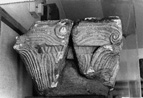
Object type: Part of capital, in two joining pieces
Measurements: H. 30 cm (11.8 in); W. 43 cm (17 in); D. 34 cm (13.4 in)
Stone type: Greyish-yellow, finely granular limestone, with some 1-mm perforations; Ditrupa limestone, Calcaire Grossier Formation, Palaeogene, Tertiary; Paris Basin
Plate numbers in printed volume: Ills. 29-32
Corpus volume reference: Vol 4 p. 131
(There may be more views or larger images available for this item. Click on the thumbnail image to view.)
Present Location
Historic Buildings and Monuments Commission Stores, Dover castle (reg. no. 78203098)
Evidence for Discovery
Found in 'recent' excavations when first recorded in 1917 (Hope 1917, 24)
Church Dedication
St Augustine's abbey
Present Condition
Heavily damaged below; otherwise crisp
Description
The decoration is divided into three zones of which the lower is the principal. This is of square plan above and circular plan below, each of the angles being rounded and decorated with a narrow, parallel-sided, upright leaf having a rounded, out-turned end and carved as if composed of a number of receding layers. On the vertical axis of each face is a similar shorter leaf separated from those at the angles by a pair of similar, but recessed leaves with their tips truncated. The leaves at the angles support a narrow block of square plan, in the lower corners of each face of which is a tight volute. The volutes on each face are linked by a band carved as if it were composed of several overlapping layers, which curves down in a swag to pass below a rosette on the vertical axis of the face. The upper and lower elements of the capital, linked by the leaves at the angles, are elsewhere separated by a narrow recessed zone decorated with narrow relief bands forming a zig-zag pattern. Each of the triangular fields thus created has two vertical facets.1
Discussion
This capital is decorated on all four faces and must derive from a free-standing column. Such columns are unusual in the pre-Conquest architecture of south-east England; they occur elsewhere only at Reculver no. 4 (Ills. 123–38) and Canterbury (St Pancras) no. 1 (Ills. 59–60). Unlike other pre-Conquest sculptures from the site, it seems that this capital came from somewhere other than the foundation of the Romanesque screen which overlay the western part of Abbot Wulfric's rotunda. Hope's description of the discovery of the sculpture is, however, remarkably vague and ambiguous, 'The remarkable capital shewn in Fig. 13 and another like it, may have been part of Wulfric's work: the smaller fragments, which are also pre-Conquest, were embedded in the destroyed screen foundations' (Hope 1917, 24).
Date
Ninth century
References
Hope 1917, 24, fig. 13; Peers 1927a, 215, pl. XXVIII; Clapham 1930, 126; Cottrill 1931, appendix; Rice 1952, 145; Taylor and Taylor 1966, 48 - 9, fig. 20; Gem 1973, ii, 439, 455; Tweddle 1983b, 35 - 6, pl. Xa; Tweddle 1986b, i, 58 - 9, 157 - 9, ii, 362 - 3, iii, pl. 29a; Webster and Backhouse 1991, 34 - 5, no. 18
D.T.
Endnotes
