Select a site alphabetically from the choices shown in the box below. Alternatively, browse sculptural examples using the Forward/Back buttons.
Chapters for this volume, along with copies of original in-text images, are available here.


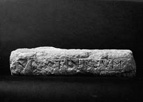
Object type: Part of grave-marker [1]
Measurements: H. 6.3 > 6 cm (2.5 > 2.4 in); W. 31.6 > 30.05 cm (12.5 > 12 in); D. 23 > 14 cm (9 > 5.5 in)
Stone type: Yellowish-grey, medium- to coarse-grained, shelly, oolitic limestone; Combe Down Oolite, Great Oolite Formation of the Bath area, Great Oolite Group, Middle Jurassic
Plate numbers in printed volume: Ills. 490-493
Corpus volume reference: Vol 4 p. 273-274
(There may be more views or larger images available for this item. Click on the thumbnail image to view.)
Only one face is carved. The four other surviving faces of the stone are dressed with diagonal tooling. On face F (bottom) this continues on the lower face to a depth of between 17 and 13 cm, at which point the face breaks forward to a more roughly tooled surface, much of which has been lost.
A: On the narrow complete face is an inscription, contained within framing lines above, below, and perhaps also to the left (but see Inscription, below). The right-hand edge of the stone is complete, but the right-hand framing line is absent.
Inscription The inscription (Okasha 1971, 127–8; eadem 1983, 110) is set between two incised guide-lines, which are set about 3 cm (1.2 in) apart (Ill. 490). It is probable that the inscription is incomplete as it stands. The vertical line to the left of the first V looks at first sight like the left end of the incised frame but it is unlikely to be so, given that it stops short of where it would have met the lower horizontal framing line. It is more probably a letter or part of one (see below), in which case the inscription is incomplete at the beginning. The gap after the final M suggests that the text stopped here but there is no indication of a vertical framing line linking the horizontals at the end of the inscription. The letters are small (around 1.9 > 2 cm (0.75 > 0.8 in) high). The inscription is in capitals and, although the surface is damaged, it remains largely legible:
--[I]V[IV]ATI[NEV]VM--
The language is clearly Latin and the reading is plain except at the beginning:
--[I] VIVAT IN EVVM--
(Translation: '-- may he/she live for ever --'). If the vertical stroke before the first V is indeed a letter or part of one (see above), I is perhaps the most likely, but not the only possible, reading. As it now stands the text lacks an explicit subject.
The lettering is small and regular. Neat serifs can still be seen on some letters, for example, the cross-bar of the T. The forms are Roman, but only seven different letters are represented. A has no top bar and its cross-bar is inclined a little down to the right. The outer strokes of the M are vertical and its central 'V' occupies only the upper part of the letter. There is no word-division nor any trace of punctuation.
The change from smooth to rough tooling on the lower face of the stone should be compared to the treatment of the lower parts of other stones from Winchester which were certainly meant to be set upright in the ground as grave-markers (e.g. Old Minster nos. 2 and 4 (Ills. 498, 503). If no. 1 was also meant to be set upright, it could have been either the head- or foot-stone of a grave with the name of the deceased on a stone at the other end; or it might have been a part of a kerb around the grave. The grave-marker at Whitchurch, Hampshire (Ills. 482, 485–9) provides a parallel for a Latin inscription on the upper edge of a memorial stone, and the runic inscription from the city (Winchester St Maurice 1; Ills. 667–70; Fig. 42)) appears to have been similarly placed (Kjølbye-Biddle and Page 1975).
Inscription The formula is likely to have been memorial. A fragmentary Early Christian inscription from the cemetery of Priscilla in Rome ('-um ut uiuat in aeuum') matches the Winchester words (Diehl 1925–67, i, 428–9, no. 2188), but I can find no other close parallels. In the Vulgate in aeternum is frequent but there are only two cases of in aevum (Ecclesiasticus 41, 16 and Baruch 3, 3). The sentence implies a subject, probably the name of the person commemorated. This might have appeared on the left of the present text, or perhaps on an adjacent stone.
The archaeological context in which this stone was found suggests that it came from a monument that was displaced at the time of the construction of the New Minster. The inscription would therefore date from before c. 901–3. It is therefore one of the earliest surviving Anglo-Saxon inscriptions in the south-east and provides interesting evidence that Roman capitals were being used in Winchester for inscriptions on stone by the ninth century, perhaps under Carolingian influence, or possibly even earlier.
