Select a site alphabetically from the choices shown in the box below. Alternatively, browse sculptural examples using the Forward/Back buttons.
Chapters for this volume, along with copies of original in-text images, are available here.


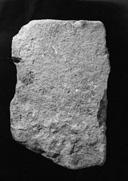
Object type: Grave-marker
Measurements: H. 70 > 69 cm (27.6 > 27.2 in); W. 47.5 > 43 cm (18.7 > 16.9 in); D. 18.5 > 14.5 cm (7.3 > 5.7 in)
Stone type: Pale brownish-grey, fine-grained limestone, with moulds of shell fragments and of Chara nucules; Bembridge limestone, Bembridge Formation, Palaeogene, Tertiary; Isle of Wight
Plate numbers in printed volume: Ills. 497-500
Corpus volume reference: Vol 4 p. 274-275
(There may be more views or larger images available for this item. Click on the thumbnail image to view.)
Only one broad face is decorated.
A (broad): The lower 27 cm or so is left roughly tooled and was meant to be buried. This lower part is recessed 1.5 cm behind the decorated surface. This consists of an arched frame surrounding a field 34.3 cm high, 37–8 cm wide, recessed 1.2 cm behind the frame. The carving is in several planes with the highest, the back of the hand, level with the surface of the frame. The relief shows a right hand coming from the left and sloping slightly downwards. The hand holds a cross between the thumb and the extended second and third fingers, the fourth and fifth fingers being folded in. The hand measures 31.5 cm from frame to fingertip; it is about 10.5 cm wide at the wrist and 13.5 cm across the thumb. The cross spans the whole field diagonally, from high right to low left. The shaft with the right edge of the cross-shaft lying below the junction between fingers and hand is 32–3 cm long and 4.2 cm wide; the arms start about 26.5 cm from the bottom and are slightly expanded. The right arm is the shortest, c. 2 cm long from the shaft, the left arm is c. 2.3 cm long. The top of the cross is 3–3.5 cm long and 3.3 cm wide. The cross-arms are 2.6–2.8 cm wide.
C (broad): The upper part is smoothly dressed, the lower (not originally intended to be visible) much more roughly finished.
The carving is confident and clever, but not expert. A feeling of greater depth is achieved by having the most prominent part, the back of the hand, at the same level as the surrounding frame, accentuating the depth of the other features. The lower right-hand edge of the cross rises onto the inner chamfer of the bottom frame, further emphasising the three-dimensional effect. There is on the stone a clear circular depression ending in a point, situated between thumb and hand. This probably marks the position from which the layout of the design was set out with a pair of compasses.
The finger position is that of a hand in blessing. The thumb is not hidden, but can be seen alongside the second finger. On the Bayeux Tapestry, in the scene where Harold swears on a shrine, his right hand is shown palm forwards but in a similar position, except that the thumb is folded completely under and would not have been visible from the back (Wilson 1985, 26). This is also the case with, for example, the middle figure on Side A of the base of the cross from Auckland St Andrew, co. Durham. This figure is giving a blessing, or could be pointing in a holy way, to the figure on the right. The figures to right and left are, however, pointing towards him using four fingers, not two, so it is likely that the middle figure is giving a blessing (Cramp 1984, i, 37–8, ii, pls. 1 (1), 5 (15)). On the painted stone from the foundation of the New Minster church (Winchester CG WS 435) one of the figures is pointing with one finger. In the contemporary illumination in the New Minster Liber Vitae, Christ in Majesty is blessing Cnut and Emma with his right hand, with the fingers as on no. 2, but with the thumb sticking up almost vertically (BL MS Stowe 944, fol. 6; Temple 1976, no. 78., ill. 244).
There is no parallel to the isolated depiction of a horizontal hand holding a cross with the fingers in a blessing position. The best parallel is the carving from Bristol cathedral showing the harrowing of Hell, where Christ holds a cross on a long staff, the cross itself being similar to that on no. 2. On the Bristol stone, Christ's left hand holds the cross and his right hand is in a blessing gesture, either in front of the cross or perhaps holding it (Stone 1955, 39, pl. 24; Zarnecki et al. 1984, 96). The Bristol stone, which is best dated c. 1050, was found in 1832 forming a coffin lid over one of twelve coffins below the chapter house. The relief, as on no. 2, occupies a field scooped out of the surface of the stone. There are also several manuscript paintings which show Christ in Majesty holding a cross on a long staff, but in his left hand, for example, Christ Enthroned with Martyrs, Confessors and Virgins in the Aethelstan Psalter (BL MS Cotton Galba A. VIII, fol. 21, 302 (Temple 1976, no. 5, ill. 33)); or Christ in Majesty from the Tiberius Psalter (BL MS Cotton Tiberius C. VI, fol. 18v (ibid., no. 98, ill. 302)). No close parallel to no. 2. has been found outside Winchester, where Winchester (New Minster) 1 (Ill. 657) and Winchester (St Pancras) 1 (Ill. 675) are of similar type. But the style of carving is similar to that seen on roods in Hampshire; for discussion and reference, see Winchester (New Minster) 1. When found, the finished east end of grave-cover no. 6 was fitted below the bottom frame of no. 2.
