Select a site alphabetically from the choices shown in the box below. Alternatively, browse sculptural examples using the Forward/Back buttons.
Chapters for this volume, along with copies of original in-text images, are available here.


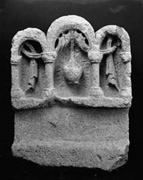
Object type: Grave-marker
Measurements: H. 63 > 61.5 cm (24.8 > 24.2 in); W. 50 > 30 cm (19.7 > 11.8 in); D. 18.5 > 9.4 cm (7.3 > 3.7 in)
Stone type: Yellowish-grey, medium- to coarse-grained, shelly oolitic limestone, including pellets up to 1 mm in length, and calcite veinlets; Combe Down Oolite, Great Oolite Formation of the Bath area, Great Oolite Group, Middle Jurassic
Plate numbers in printed volume: Ills. 502-508
Corpus volume reference: Vol 4 p. 276-277
(There may be more views or larger images available for this item. Click on the thumbnail image to view.)
The stone has a flat back and sides. The top is shaped into three arches. Only one face is decorated.
A (broad): The decoration is divided into three zones. The lowest is flat, its surface level with that of the arcades and the strip on which they stand (Ills. 506&ndah;7). The height of this zone is irregular due to the chamfers on the bottom of the stone. The middle zone is a horizontal slot, 4 cm deep and 13 cm high. There is a small square scar, 4 by 4 cm, cut diagonally into the face of the slot (Ill. 508). The upper zone, 34 cm high, consists of a deeply recessed triple arcade (maximum depth c. 7 cm) which sits on a flat base, 4 cm high. The arcade is composed of two smaller arches, that on the left 23 cm high and 11 cm wide, that on the right 24 cm high and 10 cm wide. These flank a tall central arch, 27 cm high and 16 cm wide. Four columns with moulded bases and capitals carry the arches (total height of the columns 17–18 cm, the shafts 9.6–10 cm high). From the centre of the middle arch, a lamp hangs on a long cord, attached to the rim of the lamp by three strands. The lamp has a globular body and a small foot ring. Around it radiate a series of cuts into the background of the relief. Suspended from the intrados of the central arch are curtains, which swing behind the central columns and knot themselves around the back of the smaller arcades.
B–E (back, sides and top): Smoothly dressed.
F (bottom): There is a chamfer along the front and left side, meeting in a diagonal edge. The chamfered area ends to the right in a stop with a vertical edge (Ill. 504).
The chamfers on face F and the square scar on face A suggest that the stone has been a reused as an architectural element. The horizontal slot was probably cut to take the end of a stone grave-cover, as was the case with the foot-stone for Anglo-Saxon Grave 119 (Winchester (Old Minster) no. 2 (Ill. 498); cf. the associated cover, no. 6). The present carving is probably the foot-stone from one of the several stone-covered graves found east of Old Minster, and was probably thrown with the rubble from the walls into the deep area over the aussenkrypta, together with other large stones, such as Winchester (Old Minster) no. 88. The carving is excellent, in good Winchester style.
The iconography of the curtains pulled back to reveal an important scene is common, and can be seen with a central lamp between curtains suspended from an arch in a mid twelfth-century Winchester miniature of the nativity (Temple 1976, fig. 45). Curtains hanging from rods, pulled to the side and fastened to columns, are accurately shown on mosaics and in illuminations until some stage in the late tenth century, when they begin to be shown, as on this stone, attached impractically to the underside of arches and with decorative, rather than functional, knots (Gervers 1984, 73). The arcade may be a representation of the polygonal building around the Tomb of Christ in the church of the Holy Sepulchre in Jerusalem, which from the fourth century onwards is frequently depicted as a large central arch flanked by two smaller arches, to give an illusion of perspective. In such images a lamp often hangs in the central arch between open curtains (Wilkinson 1972, 92–3). The lamp would symbolize the resurrection and eternal life, and 'the gift of the Holy Spirit, the mare vitreum, the baptism' (Sauer 1964, 227), hence the rays shining from it.
