Select a site alphabetically from the choices shown in the box below. Alternatively, browse sculptural examples using the Forward/Back buttons.
Chapters for this volume, along with copies of original in-text images, are available here.


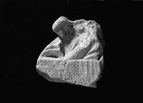
Object type: Fragment of grave-marker(?)
Measurements: H. 17 > 11 cm (6.7 > 4.3 in); W. 17 > 12 cm (6.7 > 4.7 in); D. 8.3 > 6.6 cm (3.3 > 2.6 in)
Stone type: Greyish-yellow, medium-grained oolitic limestone, with calcite veinlets; Combe Down Oolite, Great Oolite Formation of the Bath area, Great Oolite Group, Middle Jurassic
Plate numbers in printed volume: Ills. 494-496
Corpus volume reference: Vol 4 p. 276
(There may be more views or larger images available for this item. Click on the thumbnail image to view.)
This is the bottom left corner of the upper part of a stone with a complex curving outline. Two cylindrical holes rising from faces A and C have just survived in the bottom edge, one with a diameter of approximately 2.5 cm, the other of 3.4 cm.
A: Carved in its upper part and plain in the lower, a flat horizontal band 6.6 cm wide. The carving consists of the top of a circular band, a diagonal 'stem', and elaborate folds with a clearly defined frilly edge. At the extreme left-hand edge an element projects upwards.
B: Broken away.
C: Decorated with a motif of stepped triangles.
D: Smoothly dressed.
The carving is excellent, in the best Winchester style, and looks like the edges of borders of several illuminated manuscripts of the Winchester school, such as the Pentecost from the Pontifical of Archbishop Robert of Jumièges (Rouen, Bibl. Mun. Y.7, fol. 29v (Temple 1976, no. 24, frontispiece)). The stone frill seen on the present carving would give the same effect in stone as does the white lining along the edges of the draperies on many manuscripts of this school and later (see, for example, Temple 1976, no. 16, ill. 84). This piece could be part of a very elaborate grave-marker, even more elaborate than Winchester (Old Minster) no. 4 from this site.
The triangle pattern on face C is not like tegulation because the triangles with their point down are no more strongly emphasized than those with their point up. It is a very effective three-dimensional geometric pattern, stronger than that seen on Winchester (Old Minster) no. 87 (Ill. 639).
