Select a site alphabetically from the choices shown in the box below. Alternatively, browse sculptural examples using the Forward/Back buttons.
Chapters for this volume, along with copies of original in-text images, are available here.


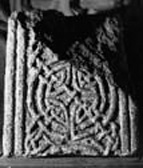
Object type: Part of cross-shaft
Measurements: H. 30 cm (11.8 in); W. 23.5 cm (9.3 in); D. 21.5 cm (8.5 in)
Stone type: Pale brownish-grey, medium- to coarse-grained, shelly oolitic limestone with planar bedding; Barnack stone, Lincolnshire Limestone Formation, Inferior Oolite Group, Middle Jurassic
Plate numbers in printed volume: Ills. 256-259
Corpus volume reference: Vol 4 p. 205
(There may be more views or larger images available for this item. Click on the thumbnail image to view.)
It is of square section and roughly broken, so that much of faces A and D is lost. All faces have double border mouldings.
A (broad): Decorated with one complete and parts of two other units of encircled pattern C interlace. At the bottom the circuiting strands are interlaced with closed-circuit loops in the spaces between the pattern units.
B (narrow): Decorated with an irregularly set-out pattern F with added outside strands and diagonals. There are angular links between the pattern units.
C (broad): There are the remains of a complex geometrical interlace, now too worn to be certain of the pattern; it may have been a form of surrounded or encircled pattern D.
D (narrow): There are the remains of a complex geometrical interlace, now too worn to be certain of the pattern; it lacks the angular links between pattern units seen on the other faces.
E (top): There is a central dowel-hole.
The parish church adjoins the site of Barking abbey, founded in the seventh century (Deansley 1961, 206), and the piece may have come from there.
The presence of a dowel hole in the upper end suggests that the rough break at this end which has involved the loss of much of faces A and D took place close to the end of a section of the shaft. The shaft may originally have been decorated solely with interlace, perhaps panelled, or alternatively, predominantly with interlace, but with the admixture of other motifs as at Bishops Waltham (Ill. 421). Not enough survives for certainty on this point. The use of encircled patterns, coupled with the disorganisation of the interlace, points to a date comparatively late in the pre-Conquest period for the piece.
