Select a site alphabetically from the choices shown in the box below. Alternatively, browse sculptural examples using the Forward/Back buttons.
Chapters for this volume, along with copies of original in-text images, are available here.


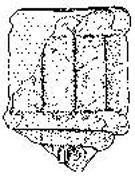
Object type: Fragment of impost
Measurements: H. 16.5 cm (6.5 in) (W. 14 cm (5.5 in); D. 12.5 cm (4.75 in)
Stone type: Unobtainable
Plate numbers in printed volume: Ills. 260-262
Corpus volume reference: Vol 4 p. 205-206
(There may be more views or larger images available for this item. Click on the thumbnail image to view.)
A corner fragment of an impost of square section, roughly broken to the rear and below. There are traces of red paint.
A: A roll moulding above and below frames a range of plain balusters in low relief, each with a rounded profile; only the one at the angle is half-round.
B: As face A.
E (top): Dressed flat.
F (bottom): Below a recessed roll moulding is a fragment of indecipherable carving.
The simplest way to view this fragment is as part of an impost, supported by a chamfered zone which also seems to have been decorated, perhaps with more baluster ornament or with conventionalized leaves; not enough survives for either interpretation to be supported.
The use of plain baluster ornament as decoration points to an early date. In south-east England its use is paralleled only at the Old Minster, Winchester (nos. 37–40, 42). In Northumbria comparable ornament occurs in late seventh- and early eighth-century contexts (see Chap. V). Such a date is perfectly consistent with the present piece. A monastery at Barking was founded by Eorcanwald, bishop of London, for his sister Aethelburh (Bede 1969, 354–7 (IV, 6)). The recent excavations have produced extensive evidence for seventh- to eighth-century activity on the site (Webster and Backhouse 1991, 67a–w).
