Select a site alphabetically from the choices shown in the box below. Alternatively, browse sculptural examples using the Forward/Back buttons.
Chapters for this volume, along with copies of original in-text images, are available here.


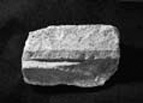
Object type: Fragment of string-course
Measurements: H. 14.5 > 10 cm (5.7 > 3.9 in); W. 22 > 17.5 cm (8.7 > 6.9 in); D. 7.5 > 2.5 cm (3 > 1 in)
Stone type: Greyish-yellow, medium- to coarse-grained, oolitic limestone, with a calcite veinlet; Combe Down Oolite, Great Oolite Formation of the Bath area, Great Oolite Group, Middle Jurassic
Plate numbers in printed volume: Ill. 541
Corpus volume reference: Vol 4 p. 288
(There may be more views or larger images available for this item. Click on the thumbnail image to view.)
The piece is competently carved. Its surviving height is 14.2 cm (5.6 in). Since it looks as if the bottom of the string might have been near, the total height of the block probably did not much exceed 14.2 cm. This piece is very like, but not identical to, Winchester (Old Minster) no. 28, found near-by. They have the same overall projection and could have been part of the same string.
H. M. Taylor discusses and analyses string-courses (Taylor and Taylor 1965–78, iii, 902–14, figs. 696–8). Nos. 27 and 28 seem more elaborate than the strings with hollow chamfers he describes, which are generally from early churches, and are best placed amongst the moulded string-courses which come from churches of a wide date span. Moulded string-courses occurred seven times, that is, in eight per cent of the 88 churches accepted as Anglo-Saxon on primary and secondary evidence.
